Timer Switch — Countdown and Programmable Wall Control
A timer switch is a wall control that turns a light, fan, or other load off after a preset amount of time or on a programmed schedule.
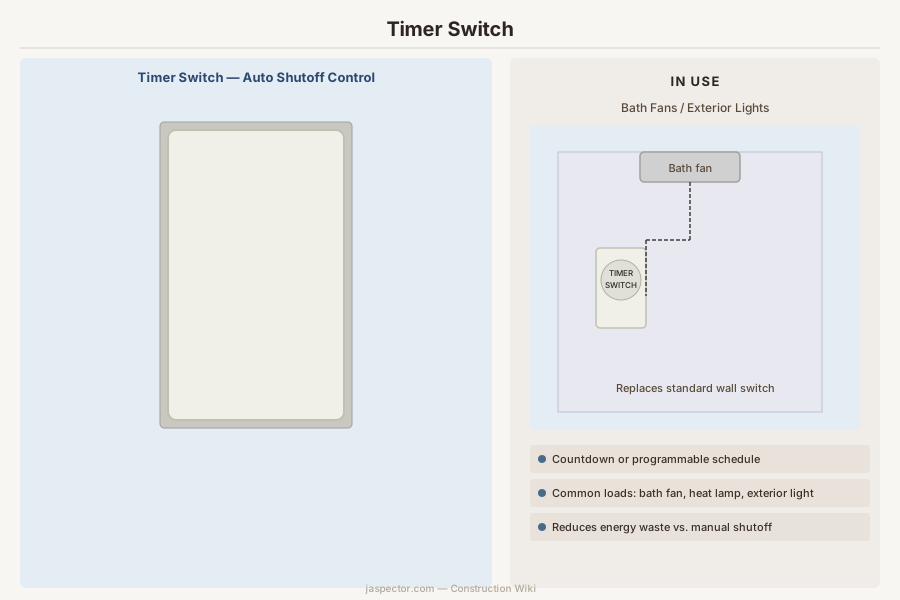
What It Is
In homes, a timer switch most often replaces a standard wall switch for a bathroom exhaust fan, heat lamp, exterior light, or hot-water recirculation pump. Some models count down for a set number of minutes after a button press, while others use a 7-day programmable schedule to turn loads on and off at specific times each day.
The point is control without relying on memory. A bathroom fan timer ensures the fan runs long enough after a shower to clear moisture and reduce mold risk, then shuts off automatically. An outdoor lighting timer turns porch and landscape lights on at dusk and off at a set hour, saving energy without requiring the homeowner to remember. Timer switches fit in a standard single-gang wall box and connect to the same 14 AWG or 12 AWG branch circuit wiring as the switch they replace.
Types
Spring-wound countdown timers are the simplest and most affordable type. A rotary dial is twisted to the desired run time (typically 5 to 60 minutes), and a mechanical spring returns the dial to zero, opening the circuit when time expires. These require no neutral wire and work with any resistive or motor load up to their rated amperage.
Electronic push-button countdown timers offer preset time intervals, commonly 5, 10, 15, 30, and 60 minutes, selected by pressing a button. They use a solid-state relay instead of mechanical contacts, and many models include a small LED indicator showing the remaining time. In-wall programmable time switches replace a standard switch and have a digital display and buttons for setting daily or weekly on/off events, similar to a programmable thermostat. Smart timer controls connect to Wi-Fi and are configured through a phone app or home automation platform, supporting voice commands, geofencing, and sunrise/sunset scheduling.
Where It Is Used
Timer switches are used for bathroom exhaust fans (where many codes now require a minimum run time after occupancy), outdoor porch and landscape lighting, attic ventilation fans, hot-water recirculation pumps, pool pumps, heat lamps, and closet lights that could be left on accidentally. They are installed in the same single-gang wall-box locations where a normal toggle or rocker switch would go.
In commercial buildings, timer switches control corridor lighting, restroom exhaust fans, and parking-area lights where occupancy-based control is not practical. Some energy codes, including ASHRAE 90.1 and Title 24 in California, require automatic shutoff controls on certain lighting circuits, and a timer switch is one of the simplest ways to comply.
How to Identify One
Instead of a simple toggle or rocker paddle, a timer switch usually has buttons, a rotary dial, or a small digital display labeled with minutes, hours, or programmed events. Spring-wound models have a round dial that protrudes from the faceplate. Electronic countdown models typically show a column of buttons with printed time values such as 10, 20, 30, and 60 minutes. Programmable time switches have an LCD screen and navigation buttons similar to a digital thermostat.
The wall plate on a timer switch may be proprietary to the device rather than a standard Decora or toggle cover, though many modern electronic timers are designed to fit behind a standard decorator plate.
Replacement
Replacement is needed when the timer no longer holds a program or loses its schedule after a power outage, the relay stops switching the load on or off, the buttons or dial mechanism fail, or the control is not compatible with the connected fixture type (for example, an older timer rated only for incandescent loads may buzz or fail with LED fixtures). The replacement must match the electrical box wiring configuration, circuit amperage, and the type of load being controlled.
Many electronic and programmable timer switches require a neutral wire in the box to power their internal circuitry. If the existing box does not have a neutral (common in older homes with switch loops), a spring-wound mechanical timer or a specific no-neutral electronic model must be selected instead.
Frequently Asked Questions
Timer Switch — FAQ
- What is the difference between a timer switch and a regular switch?
- A regular switch stays on or off until someone changes it. A timer switch adds automatic shutoff or scheduling so the connected device runs only for a chosen period or time window.
- Why would I put a timer switch on a bathroom fan?
- It keeps the fan running long enough after a shower to clear humidity without relying on someone to come back and turn it off. That helps reduce condensation and mold risk.
- Can any light or fan use a timer switch?
- No. The switch has to be rated for the specific load, especially with motors, LEDs, heat lamps, or smart fixtures. A mismatched timer can fail early or behave erratically.
- Do I need an electrician to replace a timer switch?
- Many are straightforward replacements, but line-voltage wiring is still involved. If the box wiring is unclear, there is no neutral where the control requires one, or the load is unusual, an electrician is the safer choice.
- Does a timer switch need a neutral wire in the box?
- Many electronic and programmable timer switches require a neutral connection to power their internal circuitry. Spring-wound mechanical timers typically do not need a neutral.
Have a question about your project? Get personalized answers from our team — $9/mo.
MembershipAlso in Electrical
- Range Outlet Appliance Circuits
- Appliance Whip Appliance Connections
- Dishwasher Cord Appliance Connections
- Dryer Cord Appliance Connections
- Range Cord Appliance Connections
- Generator Backup Power
- Transfer Switch Backup Power
- Box Cover Boxes