Start Capacitor - Motor Starting Boost Component Guide
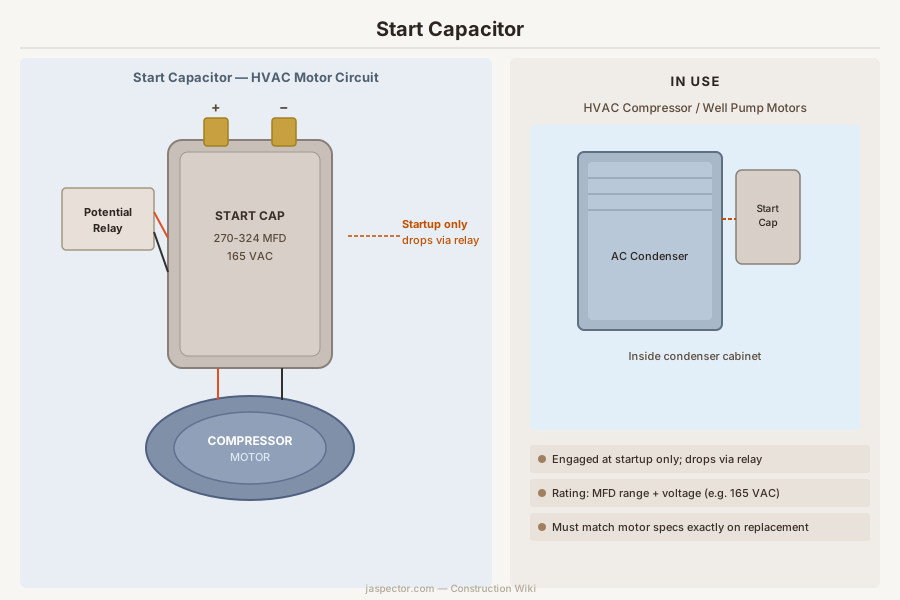
A start capacitor is an electrical component that gives a motor extra starting torque for a brief moment as it begins turning.
What It Is
A start capacitor is used on motors that need an extra boost to overcome inertia at startup. Unlike a run capacitor, it does not stay in the circuit continuously. It is engaged only during startup and then drops out through a relay, switch, or electronic control.
In residential settings, start capacitors are found in some air conditioning compressors, pumps, air compressors, and heavy-duty motor-driven equipment. When a start capacitor fails, the motor may hum, trip a breaker, or struggle to start under load.
Where It Is Used
Start capacitors are used in HVAC compressors, well pumps, garage or shop equipment, and other single-phase motors that need higher startup torque. They are less common on simple fan motors that only use run capacitors.
How to Identify One
A start capacitor is usually housed inside an equipment compartment and labeled with a microfarad range and voltage rating. It is often larger than a run capacitor of the same system and may be paired with a potential relay or start kit components.
Replacement
Replacement must match the specified capacitance range and voltage rating for the motor circuit. Because capacitors can store a charge and motor starting circuits can be misdiagnosed, replacement is an electrical or HVAC service task rather than a casual trial-and-error parts swap.
Frequently Asked Questions
Start Capacitor — FAQ
- What is the difference between a start capacitor and a run capacitor?
- A start capacitor is only in the circuit during startup to give the motor extra torque. A run capacitor stays in the circuit while the motor operates and helps it run efficiently.
- How do I know if a start capacitor is bad?
- Common signs are a motor that hums but will not start, repeated breaker trips, or equipment that starts only intermittently. A swollen case or leaking oil is a strong clue, but the proper diagnosis still requires electrical testing.
- Can I replace a start capacitor myself?
- It is possible but not low-risk. The part must be matched correctly, the stored charge has to be handled safely, and the real failure may be in the relay or motor rather than the capacitor itself.
- Why does a motor need a start capacitor?
- Some single-phase motors need extra torque to get the rotor moving from a dead stop. The start capacitor provides that short burst so the motor can reach operating speed.
- Do all AC units have a start capacitor?
- No. Many residential systems use only a run capacitor, while some add a start capacitor or hard-start kit to help the compressor start more reliably. The exact setup depends on the equipment design.
Have a question about your project? Get personalized answers from our team — $9/mo.
MembershipAlso in HVAC
- Air Handler Air Distribution
- Register Air Distribution
- Return Air Grille Air Distribution
- HVAC Filter Air Filtration
- Heat Strip Air Handler Components
- Heating Coil Air Handler Components
- Furnace Blower Air Movement
- Air Filter (HVAC) Air Quality & Filtration