Quarter-Round — Trim Molding for Floors and Cabinets
A quarter-round is a small molding with a quarter-circle profile installed where flooring, baseboards, or cabinets meet an adjacent surface to conceal gaps and create a clean transition.
What It Is
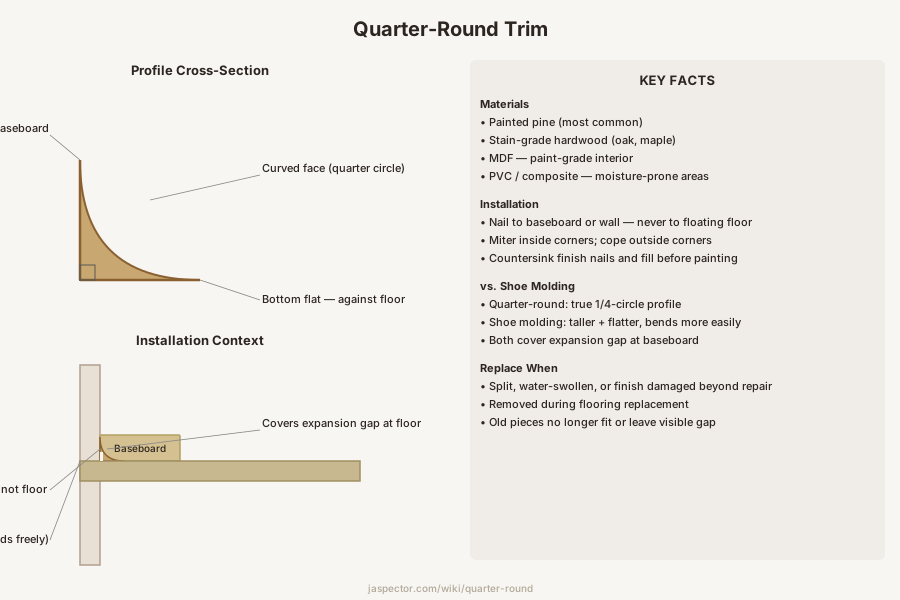
Quarter-round gets its name from its cross-section, which matches exactly one quarter of a circle. The two flat back sides meet at a 90-degree angle and press against the baseboard face and the floor surface, while the curved front face creates a smooth visual transition. It is installed as finish trim to hide expansion gaps, uneven edges, and small inconsistencies at the junction between two surfaces.
Quarter-round is not the same as baseboard, though it is frequently applied against the base of a baseboard to cover the gap above a finished floor. Floating floors such as laminate, engineered hardwood, and luxury vinyl plank require an expansion gap of 1/4 to 3/8 inch around the perimeter, and quarter-round is the standard trim piece used to conceal that gap without pinning the floor down.
Types
Common types include painted finger-joint pine, stain-grade solid hardwood such as oak or maple, MDF wrapped in a primed paper or vinyl film, cellular PVC for wet areas, and prefinished composite quarter-round that matches specific laminate or luxury vinyl flooring lines. Standard dimensions are 3/4 inch by 3/4 inch, though smaller 1/2-inch-by-1/2-inch profiles exist for delicate trim applications.
Shoe molding is a close cousin with a taller, flatter profile, typically 1/2 inch wide by 3/4 inch tall, that bends more easily against uneven floors. Cove molding is another alternative with a concave face instead of a convex one. In high-moisture areas like bathrooms and kitchens, PVC quarter-round resists swelling and rot that would affect wood or MDF versions.
Where It Is Used
Quarter-round is used along baseboards after flooring installation, at cabinet toe-kicks, around kitchen islands, along stair skirt boards, and in other finish transitions where a narrow trim piece must close a visible gap. It is common in both new construction and remodeling projects, particularly when new flooring is installed over an existing subfloor and the existing baseboards are left in place.
In commercial interiors, quarter-round or shoe molding is used at the base of wall panels, display cases, and built-in millwork. It appears in virtually every room that has baseboard trim and a hard-surface floor with an expansion gap requirement.
How to Identify One
Look for a slim molding with a consistent curved face and two flat back sides that meet at a right angle. It is usually nailed or glued at the bottom edge of baseboard or cabinetry and follows the floor line continuously around the room. The profile is symmetrical, meaning either flat face can go against the wall or the floor.
Quarter-round is typically finished to match the baseboard paint or stain color. It is fastened with 18-gauge brad nails driven at a slight downward angle into the baseboard, not into the floor, so the floating floor remains free to expand and contract beneath it.
Replacement
Replace quarter-round when it is split, swollen from water, badly scuffed beyond touch-up, or removed during flooring replacement. New pieces need to match the existing profile, material, and finish so the trim line stays consistent around the room. Miter joints at inside and outside corners should be cut at 45 degrees with a miter saw for a tight fit.
When removing old quarter-round, use a thin pry bar and work slowly to avoid damaging the baseboard behind it. If the existing pieces come off cleanly, they can often be reinstalled after new flooring goes in, saving the cost of new material and the effort of matching paint or stain.
Frequently Asked Questions
Quarter-Round — FAQ
- What does quarter-round do?
- It covers the expansion gap between a floating floor and the baseboard, hides uneven floor edges, and gives trim joints a clean, finished appearance.
- What is the difference between quarter-round and shoe molding?
- Quarter-round has a true quarter-circle profile, while shoe molding is slightly taller and thinner with a less rounded shape. Both cover gaps, but shoe molding bends more easily against uneven floors.
- Is quarter-round required with new flooring?
- Not always. It is used when the existing baseboard stays in place and the new floor needs a clean way to cover the expansion gap. Removing and resetting the baseboard is the other common approach.
- Can quarter-round be glued instead of nailed?
- Yes, especially on cabinets or masonry-adjacent surfaces, but nails are more common on wood trim. The key is fastening it to the wall or baseboard, not pinning it tightly into a floating floor.
- When should quarter-round be replaced?
- Replace it when the finish is damaged beyond touch-up, the wood has swollen from moisture, or the old pieces no longer fit after floor work. Trim that pulls loose or leaves a visible gap should also be changed.
Have a question about your project? Get personalized answers from our team — $9/mo.
MembershipAlso in Structural
- Access Panel Access & Openings
- Attic Hatch Access & Openings
- Construction Adhesive Adhesives & Sealants
- J-Bolt Anchorage
- Expansion Anchor Anchors & Fasteners
- Molly Bolt Anchors & Fasteners
- Baffle (Attic Rafter Vent) Attic & Roof
- Attic Hatch Cover Attic Access