Photo-Eye — Home Identification and Replacement Guide
A photo-eye is the infrared safety sensor mounted near the bottom of a garage door opening that detects obstructions and reverses the door if the beam is interrupted during closing.
What It Is
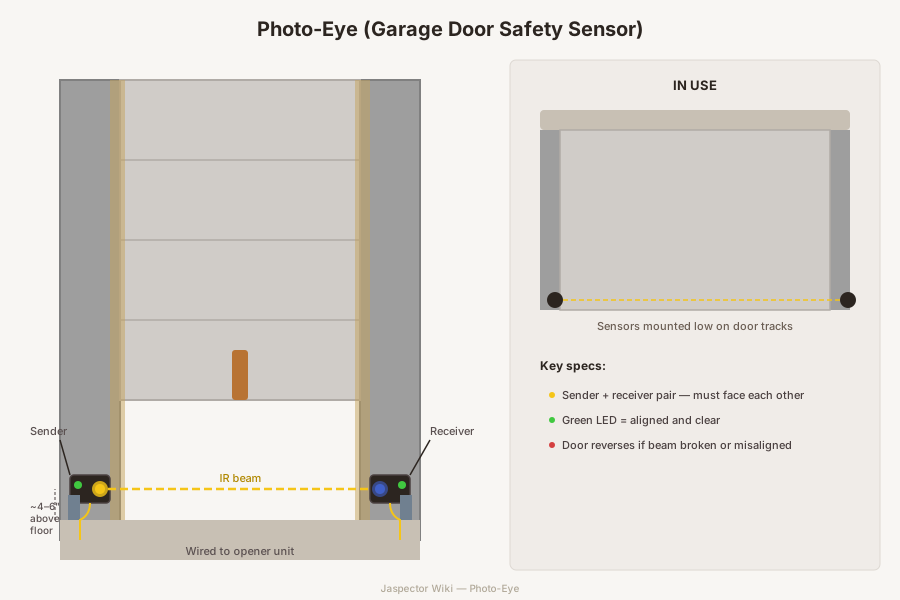
A photo-eye system consists of two small sensor units mounted on opposite sides of the garage door opening, typically 4 to 6 inches above the floor. One unit is the infrared transmitter and the other is the receiver. The transmitter projects an invisible beam across the opening, and the receiver detects it continuously while the door is in motion.
If the beam is broken by a person, pet, or object while the door is closing, the opener immediately stops and reverses the door. This safety mechanism has been required by UL 325 on all residential garage door openers manufactured after January 1, 1993. The photo-eye works alongside the door's mechanical auto-reverse to provide two independent layers of entrapment protection.
The sender and receiver use a modulated infrared signal rather than a simple light beam, which helps reject interference from sunlight. Despite this, direct afternoon sun hitting the receiver lens remains one of the most common causes of false obstruction signals.
Types
Manufacturer-matched wired photo-eyes are the most common type. They connect to the opener's control board through low-voltage wiring, typically 18 to 22 gauge bell wire, run along the ceiling and down to each sensor.
Wireless photo-eye sensors communicate with the control board via radio frequency, eliminating the need to run wires across the garage. These are useful for retrofit installations where routing new wiring is difficult.
Universal replacement photo-eyes from aftermarket suppliers can work with multiple opener brands, though compatibility with the control board's diagnostic system and voltage must be verified before purchase.
Where It Is Used
Photo-eyes are installed on all modern automatic garage door openers, whether single-car (8 to 9 feet wide) or double-car (16 feet wide). They are a federally mandated safety feature, not an optional accessory.
The sensors mount to the vertical door track, the wall near the track, or to dedicated brackets near floor level. In double-wide openings the beam must cross the full width, so alignment becomes more critical as the span increases.
How to Identify One
Look near the bottom of the garage door opening on both sides for two small sensor heads, each roughly thumb-sized, facing each other. One or both will have LED indicator lights: a steady green typically means the beam is aligned, while amber or red lights indicate power or alignment problems.
The sender side usually shows a steady LED regardless of alignment. The receiver LED is the diagnostic indicator. If it is off or blinking, the beam is blocked or the sensors are misaligned. Most manufacturers use specific blink codes documented in the opener's manual.
Replacement
Before replacing, rule out common non-hardware issues. Clean both lenses with a soft cloth, check that brackets are tight and sensors aim at each other, and inspect wiring for breaks or corrosion at the terminals and at the control board.
If the sensor still cannot produce a stable signal after cleaning and adjustment, replacement is warranted. Cracked housings, corroded boards, and rodent-damaged wiring are the most common hardware failures. Replace both sender and receiver as a matched pair for proper compatibility. After installation, test by placing an object in the beam path while the door closes to confirm prompt reversal.
Frequently Asked Questions
Photo-Eye — FAQ
- What does photo-eye do?
- Photo-Eye is used to sense obstructions in the garage door opening and stop the door from closing on them. In a home, it matters because these sensors are a core garage-door safety feature, not just a convenience accessory.
- Where is photo-eye usually found?
- It is usually found low on each side of the garage door opening near the vertical track. Homeowners most often notice it when inspecting or repairing the surrounding system.
- How do I know if photo-eye needs replacement?
- Replacement is usually needed when the opener keeps reporting a sensor fault or the door reverses despite clean, aligned sensors. Visible wear, leaks, movement, or poor performance are the usual warning signs.
- Can I repair or replace photo-eye myself?
- Many homeowners can replace matching sensors since the wiring is low-voltage and the mounting is straightforward. However, if the problem persists after sensor replacement, the issue may be in the opener's control board or wiring run, which requires more careful diagnosis.
- Why does my garage door reverse on sunny afternoons?
- Direct sunlight hitting the receiver lens can overwhelm the infrared signal and trick the system into thinking the beam is blocked. Repositioning the receiver slightly, adding a small sun shade over the sensor, or replacing with a model that has better sun filtering can resolve this common issue.
Have a question about your project? Get personalized answers from our team — $9/mo.
MembershipAlso in Exterior
- Extension Ladder Access & Safety
- Concealed Hinge Cabinet Hardware
- Board and Batten Cladding
- EIFS (Exterior Insulation Finish System) Cladding
- Hardboard Siding Cladding
- Shake Siding Cladding
- Siding Cladding
- Stone Veneer Cladding