Mudsill — Pressure-Treated Sill Plate on Foundation
A mudsill is the pressure-treated lumber plate bolted to the top of a foundation wall that supports the wood framing above.
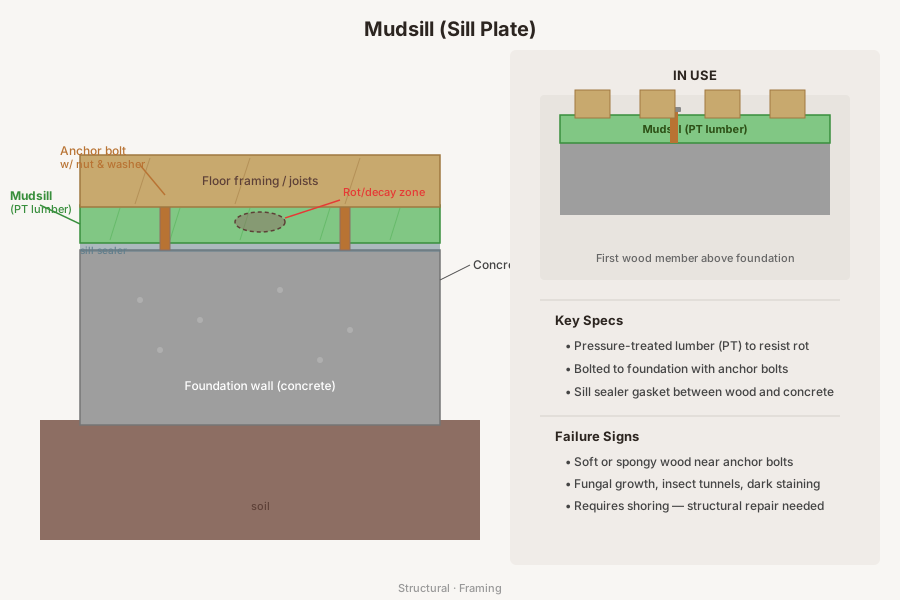
What It Is
Also called a sill plate, the mudsill is the first wood member in the framed structure above the concrete or masonry foundation. Anchor bolts or straps tie it to the foundation, and floor joists or wall framing bear on it to transfer loads into the structure below.
Because it sits at the transition between masonry and wood, the mudsill is vulnerable to rot, insect damage, and moisture problems if water reaches it repeatedly. It also plays an important role in resisting uplift and sliding loads during wind or seismic events.
Types
Most residential mudsills are pressure-treated dimensional lumber sized to match the wall framing above, commonly 2x sill plates. In some retrofits you may also see engineered connectors, sill sealer gaskets, termite shields, or sistered repair sections added to the original sill assembly.
The exact anchorage varies by code era and local hazard exposure. Older homes may have sparse anchor bolts or weak hardware compared with modern seismic and wind-resistance requirements.
Where It Is Used
A mudsill sits directly on top of a concrete foundation wall, stem wall, or curb wall at the perimeter of the building and sometimes below interior bearing walls. In basements and crawl spaces it may be visible where the floor framing begins above the foundation.
How to Identify One
Look for the horizontal wood plate resting directly on the foundation with anchor bolts passing through it. It is usually the lowest piece of framing wood in the house. Dark staining, softness around bolt locations, fungal growth, and insect tunnels are warning signs that the mudsill may be deteriorating.
Replacement
Mudsill replacement is structural work because the loads above must be temporarily supported while damaged wood is removed and new treated lumber is installed. Localized repairs are possible when damage is limited, but severe decay often requires lifting or shoring portions of the structure. Permit review is common because anchorage and structural capacity are involved.
Frequently Asked Questions
Mudsill — FAQ
- Is a mudsill the same as a sill plate?
- Yes in most residential use. "Mudsill" and "sill plate" usually refer to the same pressure-treated plate anchored to the foundation. Some contractors use one term more than the other, but the component is the same.
- What causes a mudsill to rot?
- Repeated moisture exposure is the main cause, usually from foundation leaks, poor grading, missing flashing, plumbing leaks, or chronic crawl-space humidity. Once the wood stays damp, fungi and sometimes insects can damage it quickly.
- Can a damaged mudsill be repaired without lifting the whole house?
- Sometimes. Small sections can occasionally be repaired with shoring and localized replacement, especially in crawl spaces with good access. More extensive damage often requires significant temporary support and more invasive structural work.
- How serious is a cracked or decayed mudsill?
- It can be very serious because the mudsill transfers loads from the framing into the foundation and helps anchor the house. If it is soft, crushed, or badly split around anchor bolts, a contractor or structural professional should evaluate it promptly.
Have a question about your project? Get personalized answers from our team — $9/mo.
MembershipAlso in Structural
- Access Panel Access & Openings
- Attic Hatch Access & Openings
- Construction Adhesive Adhesives & Sealants
- J-Bolt Anchorage
- Expansion Anchor Anchors & Fasteners
- Molly Bolt Anchors & Fasteners
- Baffle (Attic Rafter Vent) Attic & Roof
- Attic Hatch Cover Attic Access