Irrigation Controller — Zone Scheduling, Types, and Replacement
An irrigation controller is a timer and control unit that tells each sprinkler or drip zone when to turn on and how long to run, automating landscape watering without manual intervention.
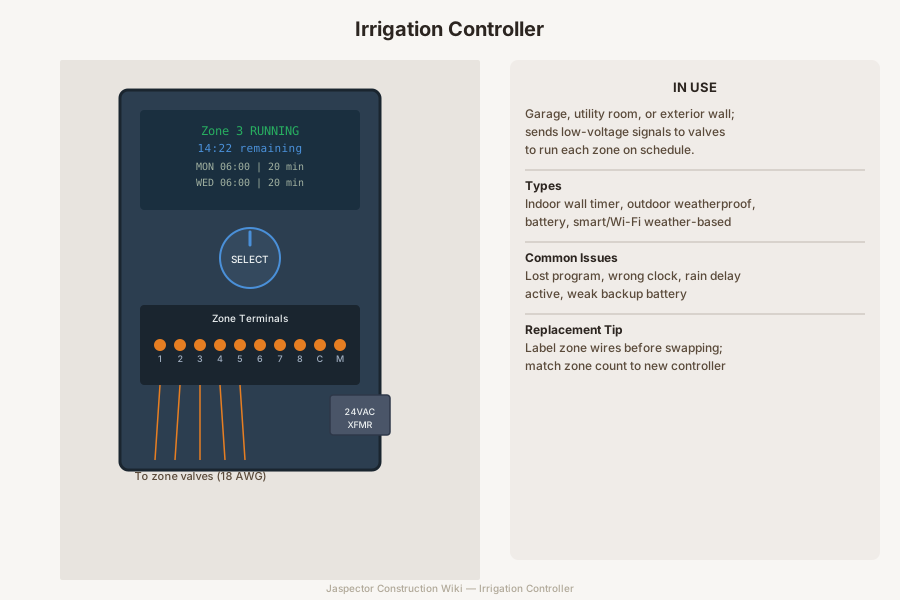
What It Is
An irrigation controller sends low-voltage 24 VAC signals to solenoid-operated zone valves so the landscape watering system operates on a schedule instead of requiring manual operation. It is the brain of the system, coordinating start times, run durations, watering days, and in many cases seasonal percentage adjustments or rain delay settings. The controller connects to each zone valve through individual 18-gauge low-voltage wires — one per zone — and to a common wire that completes the circuit, allowing it to energize and de-energize valves independently according to the programmed schedule.
Basic units use fixed programs with a mechanical or digital timer, typically offering three independent programs (A, B, C) each with multiple start times per day. Newer controllers connect to internet weather data, on-site soil moisture sensors, rain sensors, or flow meters and adjust watering automatically based on actual evapotranspiration (ET) conditions. When the controller fails or is programmed incorrectly, zones may skip watering, overwater, or run at the wrong time of day, leading to plant stress, runoff, or water waste. Power outages can erase programs on older units without battery backup, causing the system to go dormant or revert to a factory-default schedule that bears no relation to the landscape.
Most controllers include a master valve or pump start relay terminal that activates a master shutoff valve or booster pump before any zone runs. This safety feature prevents water from flowing through the mainline when no zone is active, reducing the risk of undetected leaks in the distribution piping.
Types
Indoor wall-mount controllers are protected from weather and are common in garages and utility rooms. They typically connect to a nearby 120 VAC outlet via a plug-in transformer. Outdoor weatherproof controllers are mounted on exterior walls in NEMA 3R-rated or better enclosures and are built to handle rain, UV exposure, and temperature extremes from 14 degrees F to 140 degrees F. Battery-powered controllers, usually running on a single 9-volt or two AA batteries, serve small systems of one to four zones or locations without electrical power such as remote drip zones. Smart Wi-Fi controllers adjust watering based on local weather station data and EPA WaterSense guidelines and can be managed from a phone or web app, often qualifying for utility water conservation rebates of $50 to $200.
Where It Is Used
Irrigation controllers are used in garages, utility rooms, exterior walls near the valve manifold, pump houses, and landscape equipment areas. They serve lawn sprinkler systems, drip irrigation systems, and mixed residential and commercial irrigation layouts ranging from four-zone home lawns to 48-zone commercial campuses. The controller location should be accessible for programming and service, protected from direct moisture if it is not a weatherproof model, and within reach of the zone valve wiring bundle running underground from the valve box.
How to Identify One
Look for a wall-mounted box with an LCD screen, rotary dial, membrane keypad, or smartphone-connected control module labeled with zone numbers. Low-voltage wires — typically 18-gauge solid copper in a multi-conductor direct-burial jacket — are bundled and enter the controller from below or through the back of the cabinet, landing on numbered terminal screws inside. The transformer that converts 120 VAC line voltage to 24 VAC is usually built into the controller housing. A small lithium coin cell or 9-volt battery inside the unit preserves the program memory during power outages on most models manufactured after 2000.
Replacement
Replacement is common when the display fails, the programming becomes unreliable or erratic, the cabinet fills with moisture from a cracked seal, or the system needs more zones or smart-watering capability. Swapping a controller involves photographing or labeling each zone wire with numbered tape before disconnecting it, then reconnecting in the same order on the new unit's terminal strip. Most modern controllers are compatible with existing 18-gauge low-voltage wiring and standard 24 VAC solenoid zone valves. Budget $50 to $80 for a basic timer replacement or $120 to $300 for a smart Wi-Fi controller with weather-based scheduling.
Frequently Asked Questions
Irrigation Controller — FAQ
- What does an irrigation controller do?
- It tells each zone valve when to open and how long to stay open based on a programmed schedule. Without the controller, most automatic sprinkler and drip systems will not water on their own — the homeowner would have to open each valve manually.
- Why are my sprinklers running at the wrong time?
- The controller may have lost its program, the clock may have reset after a power outage, or a rain delay or seasonal adjustment setting may be affecting the schedule. Weak backup batteries can cause the program to reset on older units. Review all three programs and the clock setting as a starting point.
- Can I replace an irrigation controller myself?
- Many homeowners can if the new controller matches the number of zones and each zone wire is clearly labeled before disconnecting the old unit. The main risk is crossing zone wires or mishandling the 24-volt AC transformer connection, which can blow a fuse or damage the new controller.
- Is it worth upgrading to a smart irrigation controller?
- Often yes, especially in climates with seasonal variation or areas subject to water restrictions. A smart controller can reduce overwatering significantly by adjusting run times to actual weather conditions, and many utility companies offer rebates that reduce the purchase cost.
- How many zones can an irrigation controller handle?
- Residential controllers range from 4-zone compact units to 24-zone or larger systems for commercial properties. When upgrading, choose a controller with at least as many zones as you currently have plus a few spare terminals for future expansion.
Have a question about your project? Get personalized answers from our team — $9/mo.
MembershipAlso in Landscaping
- Erosion Mat Erosion Control
- Berm Grading & Drainage
- Landscape Fabric Ground Cover
- Landscape Pin Ground Cover
- Pea Gravel Ground Cover & Aggregate
- Edging Board Hardscaping
- Flagstone Hardscaping
- Paver Hardscaping