Hardwood Flooring - Wood Floor Types and Repair Guide
Hardwood flooring is a finished wood floor surface made from solid wood or engineered wood planks installed over a subfloor.
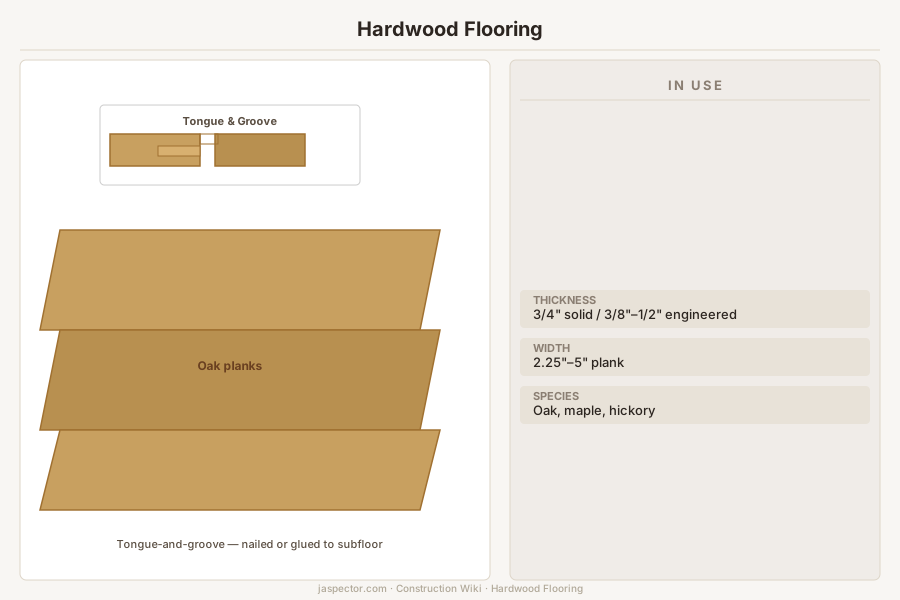
What It Is
Hardwood flooring is the exposed walking surface in a room. In homes it is valued for durability, repairability, and the ability to refinish instead of replacing the whole floor when the finish wears. A well-maintained hardwood floor can last 50 years or more and can typically be sanded and refinished three to five times.
The term covers both solid hardwood planks and engineered wood flooring with a real wood wear layer. Oak is the most common species in North American homes, followed by maple, hickory, walnut, and cherry. Each species has a different Janka hardness rating: red oak rates about 1,290, while hickory is significantly harder at about 1,820.
Solid products are typically 3/4 inch thick, while engineered products range from 3/8 inch to 3/4 inch. Widths vary from 2-1/4-inch strip flooring to wide planks of 5 inches or more.
Types
Solid hardwood strip flooring is milled from a single piece of wood with tongue-and-groove edges. Standard strip is 3/4 inch thick and 2-1/4 inches wide, nailed or stapled to a plywood or OSB subfloor. It is the most refinishable type because the full thickness is solid wood.
Wider plank flooring uses the same solid construction in widths of 4 to 12 inches or more. Wider boards move more with humidity changes and may need face-nailing in addition to blind-nailing.
Engineered hardwood flooring has a real wood wear layer bonded to a multi-ply or HDF core. The wear layer ranges from about 1 mm on economy products to 4 mm or more on premium lines. Engineered flooring is dimensionally more stable, making it suitable for concrete slabs, radiant heat systems, and climates with large humidity swings.
Site-finished flooring is installed raw and sanded and finished in place, producing a seamless surface. Factory-finished flooring arrives with stain and topcoat applied, speeding installation but leaving a slight bevel at each board edge.
Where It Is Used
Hardwood flooring is used in living rooms, dining rooms, bedrooms, hallways, and offices. It is less common in bathrooms or below-grade spaces where moisture is harder to control. Engineered hardwood extends the range to include basements and slab-on-grade construction with a proper vapor barrier.
In kitchens, hardwood demands prompt spill cleanup. In entryways, harder species like hickory or white oak handle foot traffic better than softer species.
How to Identify One
A hardwood floor has individual wood boards or planks with visible grain and seams between courses. The grain pattern is natural and non-repeating, unlike laminate flooring which prints the same image across multiple planks. Solid hardwood is usually nailed down and has full-thickness wood visible at floor vents, thresholds, or cut edges, while engineered hardwood shows a thinner real-wood top layer over a plywood or composite core when viewed from the side.
Tapping the floor can help distinguish hardwood from laminate or vinyl, as solid hardwood produces a warmer, more solid sound. Checking the edge of a board at a transition strip or floor register reveals whether the cross-section is solid wood or layered plies.
Replacement
Replacement is needed when boards cup badly, split, delaminate, suffer deep pet or water damage, or have already been sanded beyond their practical limit. Small damaged areas can sometimes be patched by cutting out the damaged section and weaving in new boards, a technique called lacing in.
Widespread moisture damage usually requires larger replacement. Before installing new flooring, the moisture source must be corrected and the subfloor tested with a moisture meter to confirm it is within the manufacturer's acceptable range, typically 6 to 9 percent. Acclimating new flooring in the room for several days before installation helps minimize post-installation movement.
When refinishing is sufficient, the process involves sanding the existing finish and applying new stain if desired plus two to three coats of polyurethane. Water-based polyurethane dries faster with lower odor, while oil-based produces a warmer amber tone.
Frequently Asked Questions
Hardwood Flooring — FAQ
- What is the difference between solid and engineered hardwood flooring?
- Solid hardwood is one piece of wood from top to bottom, while engineered hardwood has a real wood wear layer bonded to a stable core. Solid flooring can usually be refinished more times, but engineered flooring often handles seasonal movement better.
- How do I know if hardwood flooring can be refinished instead of replaced?
- If the boards are structurally sound and the wear is mostly in the finish, refinishing is often enough. Deep water damage, severe cupping, loose boards, or a thin engineered wear layer can make replacement the better choice.
- Can hardwood flooring be installed in a kitchen?
- Yes, many kitchens have hardwood floors, but spills need to be cleaned up quickly and the finish needs to stay intact. It is a workable choice, not a forgiving one.
- How long does hardwood flooring last?
- Good hardwood flooring can last for decades, and in some homes much longer, if moisture is controlled and the finish is maintained. Its lifespan depends more on abuse, water exposure, and refinishing history than on age alone.
- What causes hardwood flooring to cup or buckle?
- Cupping happens when the bottom of the board absorbs more moisture than the top, causing the edges to rise. Buckling is a more severe reaction where boards lift off the subfloor entirely due to excessive moisture from leaks, flooding, or a missing vapor barrier beneath the floor.
Have a question about your project? Get personalized answers from our team — $9/mo.
MembershipAlso in Structural
- Access Panel Access & Openings
- Attic Hatch Access & Openings
- Construction Adhesive Adhesives & Sealants
- J-Bolt Anchorage
- Expansion Anchor Anchors & Fasteners
- Molly Bolt Anchors & Fasteners
- Baffle (Attic Rafter Vent) Attic & Roof
- Attic Hatch Cover Attic Access