Foil Facing - Insulation Uses and Repair Guide at Home
Foil facing is a reflective foil layer attached to insulation or board products to act as a facing, radiant barrier, vapor retarder, or protective surface.
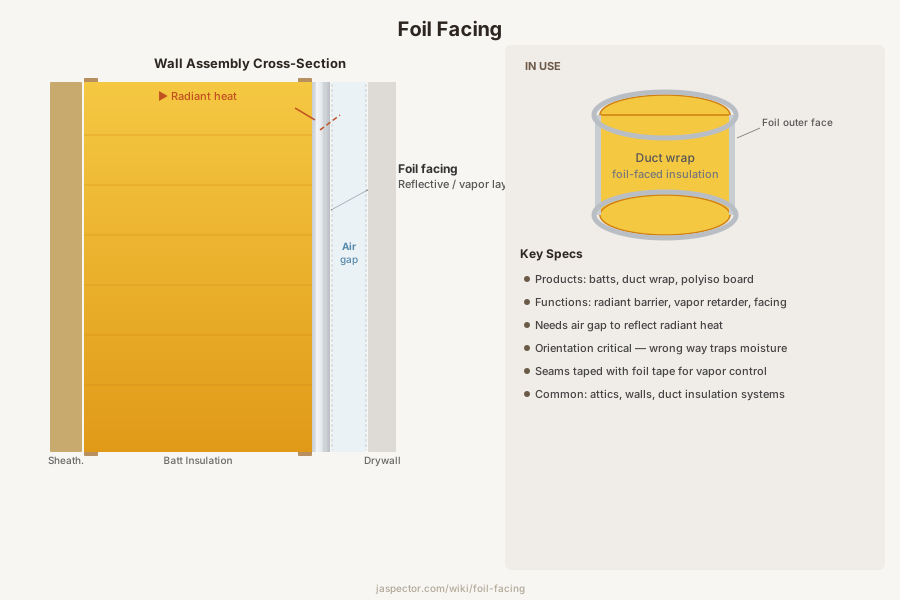
What It Is
Foil facing is bonded to one side of certain insulation products such as fiberglass batts, duct wrap, rigid board, and radiant barrier materials. Depending on the product, it can help reflect radiant heat, provide a finished surface, and slow vapor movement through the assembly.
The foil is not a standalone insulation value by itself. Its performance depends on the product it is attached to and whether the assembly includes the required air space, orientation, and seams.
Types
Common examples include foil-faced batt insulation, foil-scrim-kraft facings on duct insulation, and foil-faced polyisocyanurate board. Each product uses the facing differently, so one foil-faced material should not be assumed equivalent to another.
Where It Is Used
Foil-facing appears in attics, walls, mechanical rooms, duct insulation, and roof or wall assemblies where reflective or vapor-control properties are desired. In residential work, homeowners most often encounter it on insulation products rather than as a separate visible finish.
How to Identify One
Foil facing is the shiny metallic-looking layer on one side of the insulation or board. Tears, delamination, tape failure, or installed orientation that traps moisture are common warning signs of a problem.
Replacement
Foil-facing is replaced when the insulation product is damaged, wet, delaminated, or no longer appropriate for the assembly. Replacement should follow the product listing and the building-science intent of the assembly, because the wrong facing can create condensation or code problems.
Frequently Asked Questions
Foil Facing — FAQ
- What does foil facing do on insulation?
- It can reflect radiant heat, provide a vapor-retarding layer, and protect the insulation surface, depending on the product. Its exact function depends on the assembly, not just the presence of shiny foil.
- Is foil-facing the same as a radiant barrier?
- Not always. Some foil-faced products act as part of a radiant barrier assembly, but others are primarily facings for insulation or duct wrap. The installation details determine the result.
- Can foil-facing face either direction?
- No. Orientation matters because the facing may be intended toward conditioned space, toward an air gap, or as part of a tested assembly. Installed backward, it can reduce performance or trap moisture.
- How do I know if foil-facing needs replacement?
- If it is torn badly, delaminating, wet, moldy, or part of an insulation product that has failed, replacement is justified. Small tape repairs may be enough only when the underlying insulation is still sound and the product allows it.
Have a question about your project? Get personalized answers from our team — $9/mo.
MembershipAlso in Structural
- Access Panel Access & Openings
- Attic Hatch Access & Openings
- Construction Adhesive Adhesives & Sealants
- J-Bolt Anchorage
- Expansion Anchor Anchors & Fasteners
- Molly Bolt Anchors & Fasteners
- Baffle (Attic Rafter Vent) Attic & Roof
- Attic Hatch Cover Attic Access