Flexible Conduit — FMC and Liquidtight Raceway Types
A flexible conduit is a bendable metallic or nonmetallic raceway used to route and protect electrical wiring where rigid conduit cannot accommodate movement, vibration, or tight turns.
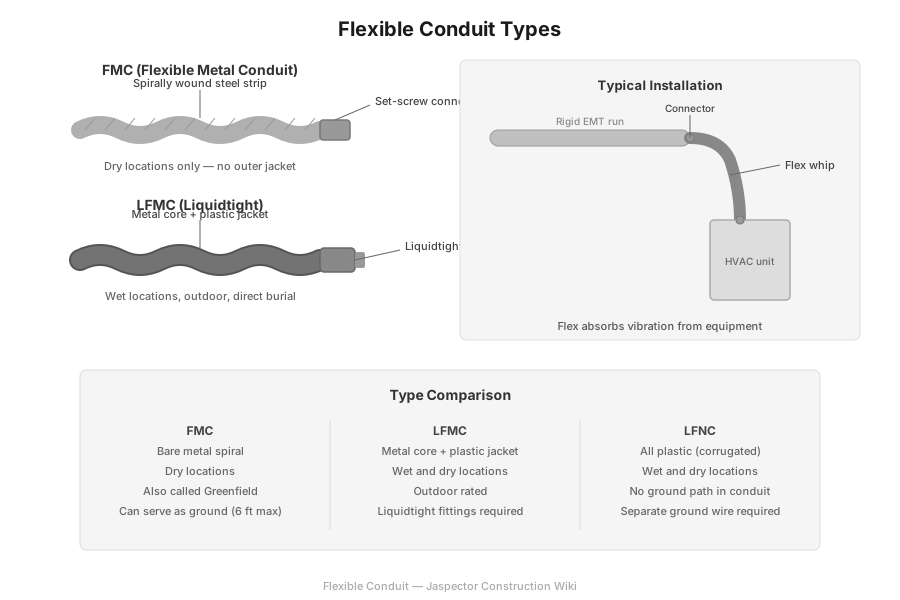
What It Is
Flexible conduit is a raceway that can bend freely to follow irregular paths, connect to vibrating equipment, or bridge the gap between rigid conduit runs and termination points. It provides mechanical protection for the conductors inside while allowing the routing flexibility that rigid conduit cannot provide. The minimum bend radius for most flexible conduit is approximately six times the internal diameter, which still allows much tighter turns than rigid EMT or IMC.
The most common metallic type is FMC (Flexible Metal Conduit), made from a spirally wound interlocking steel or aluminum strip. The interlocking design allows the tube to flex in any direction without kinking. LFMC (Liquidtight Flexible Metal Conduit) adds a thermoplastic PVC jacket over the metal core for moisture protection, making it suitable for wet locations and outdoor use. LFNC (Liquidtight Flexible Nonmetallic Conduit) is an all-plastic corrugated or smooth-wall conduit used where metal is not required and where exposure to chemicals or corrosive environments would damage metallic conduit.
Types
FMC (sometimes called Greenfield after its inventor) is the standard flexible metal conduit for dry indoor locations. It provides a continuous ground path through its metal armor on runs of 6 feet or less per NEC Article 348, though longer runs require a separate equipment grounding conductor. LFMC adds a plastic jacket and is governed by NEC Article 350; it is the preferred choice for outdoor connections and wet-location equipment such as rooftop HVAC units and pool pumps.
LFNC is entirely plastic and is used where corrosion resistance is needed or where the added weight of metal is undesirable, such as lightweight suspended-ceiling fixture connections. Reduced-wall flexible conduit is a thinner, lighter version of FMC designed for tight spaces inside equipment cabinets. Trade sizes range from 3/8 inch to 4 inches, with 1/2-inch and 3/4-inch being the most common in residential and light commercial work.
Where It Is Used
Flexible conduit is used to connect HVAC equipment, motors, garbage disposals, water heaters, light fixtures in suspended ceilings, and any equipment that vibrates or needs to be occasionally disconnected for service. It is also used for the final connection — commonly called a whip — between rigid conduit runs and electrical panels or junction boxes where alignment is difficult. In commercial construction, pre-assembled MC cable whips with LFMC tails are common for connecting recessed light fixtures and rooftop units.
Outdoor installations such as hot tub connections, sign lighting, and landscape equipment typically require LFMC or LFNC because the conduit is exposed to rain, soil contact, or irrigation spray.
How to Identify One
FMC looks like a spirally wound silver metal tube that flexes freely by hand. The spiral seam is visible as a continuous helical line along the length of the conduit. LFMC has the same metal core but is covered with a smooth plastic jacket, usually gray or black, concealing the spiral armor underneath. LFNC is entirely plastic with a corrugated or smooth profile and no metal visible at all. All types are visibly different from rigid conduit because they can bend without tools and hold whatever shape they are routed in.
Replacement
Replace flexible conduit when the metal strip is crushed or separated, when the liquidtight jacket is torn or cracked (exposing the metal core to moisture), when fittings are pulling loose from the conduit end, or when the conduit has been stretched beyond its rated bend radius. Damaged sections are cut out using a hacksaw or rotary tool and replaced using appropriate connectors — LFMC and LFNC require liquidtight fittings with compression rings to maintain their moisture rating. Standard FMC uses set-screw or squeeze connectors that clamp onto the metal armor.
Frequently Asked Questions
Flexible Conduit — FAQ
- What is the difference between FMC and LFMC?
- FMC is bare spirally wound metal conduit suitable for dry locations. LFMC adds a plastic outer jacket over the metal core, making it suitable for wet locations, outdoor use, and direct burial where the conduit may be exposed to moisture.
- How long can a flexible conduit run be?
- The NEC generally limits flexible metal conduit runs to 6 feet for equipment grounding purposes, though longer runs are permitted if a separate equipment grounding conductor is installed inside the conduit. Check NEC Article 348 for FMC and Article 350 for LFMC.
- Can flexible conduit be used outdoors?
- Standard FMC is rated for dry locations only. LFMC and LFNC with their plastic jackets are rated for wet locations and outdoor use. Always use liquidtight fittings with liquidtight conduit to maintain the moisture seal.
- Do I need to pull a ground wire through flexible conduit?
- For short runs (typically 6 feet or less), the metal armor of FMC can serve as the equipment grounding conductor. For longer runs or when using nonmetallic flexible conduit, a separate green or bare grounding conductor must be installed inside the conduit.
- How much does flexible conduit cost?
- FMC costs $0.50 to $2 per foot for common trade sizes. LFMC runs $1 to $4 per foot due to the added jacket. Fittings add $2 to $8 each. Electrician labor for a typical equipment connection using flexible conduit is $100 to $250.
Have a question about your project? Get personalized answers from our team — $9/mo.
MembershipAlso in Electrical
- Range Outlet Appliance Circuits
- Appliance Whip Appliance Connections
- Dishwasher Cord Appliance Connections
- Dryer Cord Appliance Connections
- Range Cord Appliance Connections
- Generator Backup Power
- Transfer Switch Backup Power
- Box Cover Boxes