Face Brick — Types, Weather Resistance, and Replacement
A face brick is a finish-grade masonry unit installed as the visible outer wythe of a brick wall, providing the finished appearance and weather-resistant surface.
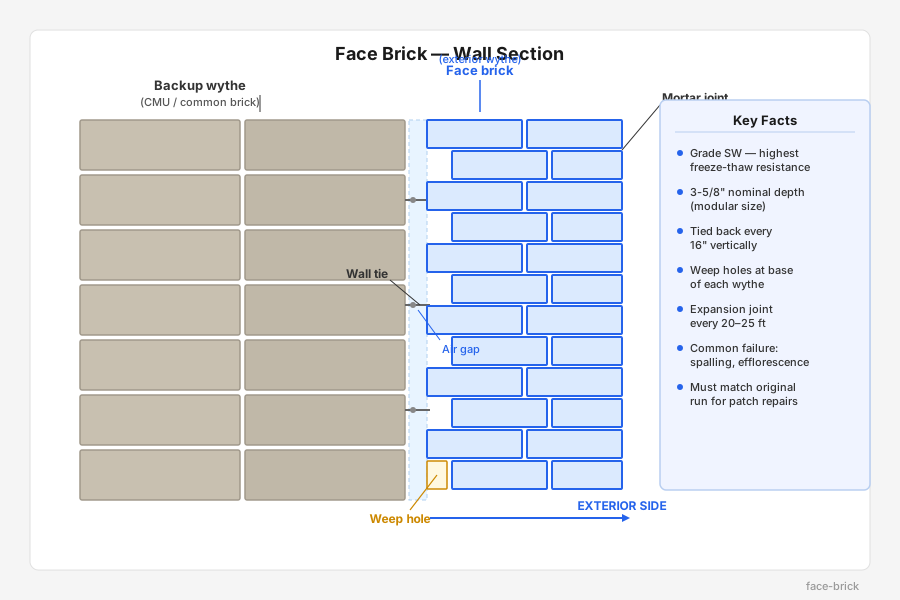
What It Is
Face brick is a fired clay or shale brick manufactured to tighter tolerances than common or backup brick. Its exposed face is uniform in texture, color, and dimension so the finished wall presents a consistent appearance. Unlike backup brick, face brick must resist moisture penetration, freeze-thaw cycling, and UV weathering because it is the element directly exposed to the elements. ASTM C216 governs face brick and classifies it into Grade SW (severe weathering) for regions with freeze-thaw exposure and Grade MW (moderate weathering) for milder climates.
The face wythe is typically one brick thick — 3-5/8 inches nominal for a standard modular unit — and is tied back to a backup wythe using corrugated or adjustable metal wall ties embedded in the mortar joints at a maximum spacing of 16 inches vertically and 24 to 32 inches horizontally. The backup wythe may be concrete block, common brick, or steel stud framing with sheathing, depending on the wall system.
Types
Face brick comes in modular (7-5/8 by 2-1/4 by 3-5/8 inches nominal), queen, king, and utility sizes. Finishes range from smooth-face extruded brick to wire-cut, sand-molded, and tumbled varieties that replicate an aged or handmade appearance. Color varies widely by clay source and kiln temperature — from pale cream and buff to deep red, brown, and near-black.
Architectural face brick carries stricter dimensional tolerances than standard face brick, with allowable size variation of just 1/16 inch. Thin brick veneer is a related product — a 1/2 to 5/8-inch-thick slice of real clay brick adhered to a substrate rather than laid in a full-thickness wythe — used for interior accent walls and lightweight exterior cladding over foam insulation panels.
Where It Is Used
Face brick is used on the exterior of residential and commercial buildings, low garden walls, chimneys above the roofline, planters, and retaining wall caps. It is the dominant cladding material in brick-veneer wall systems, which account for the vast majority of brick construction in North America. In a veneer system, the face brick is non-structural — it carries only its own weight and transfers wind loads to the backup wall through the tie system.
In historic construction, face brick may be part of a solid masonry wall with two or three wythes bonded together by header courses. Understanding the wall type is essential before any repair or alteration work is undertaken.
How to Identify One
Face brick has a smooth or deliberately textured finished face, consistent coloring from unit to unit, and sharp arrises (edges). The backup wythe behind it — when visible in a cross-section at an opening or damaged area — is typically a coarser, less uniform unit. Mortar joints on the face wythe are tooled to a concave, V-shape, or weathered profile for moisture shedding, whereas backup joints may be struck flush or left rough.
The presence of weep holes at the base of the wall — small openings in the mortar joint every 24 to 32 inches at the first course above the flashing — confirms a cavity-wall or veneer system with face brick as the outer wythe.
Replacement
Individual spalled or cracked face bricks can be cut out with a cold chisel or oscillating tool and replaced by a mason. The surrounding mortar is raked out to a depth of 3/4 inch, the old unit is removed, and a new unit is set in fresh mortar matched for color and joint profile. Matching the original color, texture, and size is the main challenge; ordering a few extra units from the original production run at the time of initial construction is standard practice.
Widespread delamination or separation of the face wythe from the backup wythe requires structural investigation and repair of the wall-tie system, which may involve removing sections of brick, installing new ties, and rebuilding the face wythe.
Frequently Asked Questions
Face Brick — FAQ
- What is the difference between face brick and common brick?
- Face brick is manufactured to tighter tolerances and has a finished appearance suitable for exposed surfaces. Common brick, also called building or backup brick, is used where it will not be seen and is not graded for weather resistance or consistent appearance.
- How do I match face brick for a repair?
- Bring a sample to a masonry supplier and compare color, texture, surface finish, and nominal dimensions. Brick color can change between production runs, so older homes often require sourcing salvaged brick or a custom blend. The mortar color and joint profile matter as much as the brick itself.
- Does replacing face brick require a permit?
- Patching a few individual bricks generally does not require a permit. Removing and rebuilding a large section of wall — especially on a load-bearing or veneer-tied assembly — may require a building permit and engineering review depending on your jurisdiction.
- How long does face brick last?
- Quality face brick in a well-built wall can last 75 to 100 years or more. Deterioration is usually driven by failed mortar joints, water infiltration behind the wythe, inadequate weep holes, or missing expansion joints that allow thermal stress to accumulate.
- What causes face brick to spall?
- Spalling is most often caused by water trapped inside the brick freezing and expanding during winter. Underfired brick, mortar that is harder than the brick, and blocked weep holes that prevent drainage all accelerate spalling. SW-grade brick has the highest freeze-thaw resistance.
Have a question about your project? Get personalized answers from our team — $9/mo.
MembershipAlso in Masonry
- Epoxy Anchor Anchors & Fasteners
- Masonry Anchor Anchors & Fasteners
- Wall Tie Anchors & Fasteners
- Arch Brick
- Brick Ledge
- Corbel
- Tuckpointing Mortar
- Smoke Chamber Chimney Masonry