Engineered Hardwood — Multi-Layer Wood Flooring Types
An engineered hardwood floor is a multi-layer wood panel with a solid hardwood veneer face bonded to cross-laminated plywood or HDF core plies that resist warping and moisture movement better than solid lumber.
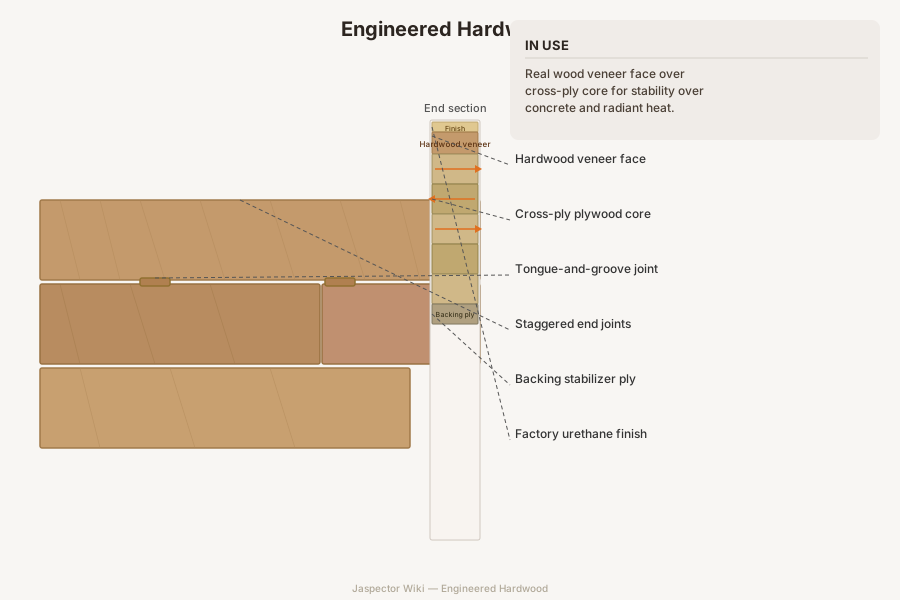
What It Is
Engineered hardwood consists of three to twelve layers of wood bonded together with the grain of each layer running perpendicular to its neighbor. The total plank thickness typically ranges from 3/8 inch to 3/4 inch, with widths from 3 inches to 7 inches or wider in premium products. The face layer is a real hardwood veneer — oak, hickory, maple, walnut, or other species — that provides the appearance and wear surface. The core layers are typically hardwood or softwood plywood or high-density fiberboard arranged in a cross-ply orientation that minimizes seasonal expansion and contraction.
Because the dimensional movement of the product is controlled by the cross-ply construction, engineered hardwood can be installed over radiant heat, on below-grade slabs, and in environments where solid hardwood would cup or gap. The face veneer thickness determines how many times the floor can be sanded and refinished over its life. A plank with a 1/16-inch veneer cannot be refinished, while a 1/4-inch veneer supports two to three full sand-and-refinish cycles.
Types
Veneer thickness varies from 1/12 inch (rotary-peeled, not refinishable) to 1/4 inch (sawn face, up to three refinishes). Core types include Baltic birch plywood for dimensional stability, HDF for flatness and moisture resistance, and lauan plywood for budget products. Finish options include factory-applied aluminum oxide urethane rated at AC3 or AC4 wear class, oil-penetrating finishes that can be spot-repaired, and wire-brushed or hand-scraped textures that mask minor wear.
Click-lock planks float over the substrate on a foam or cork underlayment and require no adhesive. Tongue-and-groove planks are stapled, nailed, or glued down for a more permanent installation. Glue-down installation is preferred over concrete slabs because it eliminates hollow spots and reduces the chance of plank movement.
Where It Is Used
Engineered hardwood is used in living rooms, bedrooms, hallways, kitchens, and basement-level spaces where solid hardwood is not practical. It is a popular choice over radiant hydronic heat because its low expansion rate — typically 1/32 inch or less across a 5-inch plank over a 4-percent moisture-content swing — reduces gapping and popping.
It is also common over existing tile, hardwood, or concrete slabs when the homeowner wants a wood appearance without full demolition. In multi-story condominiums, engineered hardwood is often specified because the thinner profile fits within the available floor-to-ceiling height after accounting for the structural slab, underlayment, and the required sound-control mat.
How to Identify One
Look at the end of a plank at a doorway or vent cut. Engineered hardwood shows distinct layer lines — the thin face veneer over multiple core plies with alternating grain direction — while solid hardwood shows uniform wood grain throughout the thickness. The core plies are typically lighter in color than the face veneer and may show glue lines between layers.
Another indicator is the plank edge profile. Floating-floor products have a visible click-lock mechanism on the long and short edges that is absent on solid hardwood tongue-and-groove boards.
Replacement
Replace engineered hardwood when the face veneer has worn through to the core, when planks are cupped from prolonged moisture exposure, when the subfloor beneath has moved and caused widespread gapping, or when finish refinishing has been exhausted and the surface has deteriorated beyond sanding. Individual damaged planks in a glue-down installation can be cut out with an oscillating multi-tool and replaced, though color matching with the surrounding aged planks is a common challenge.
For floating-floor installations, planks must be disassembled from the nearest wall to reach the damaged section, which can make spot repairs impractical in large rooms.
Frequently Asked Questions
Engineered Hardwood — FAQ
- Can engineered hardwood be refinished?
- It depends on the face veneer thickness. A 1/12-inch veneer can typically not be refinished. A 3/16 or 1/4-inch veneer can usually be lightly sanded and refinished two to three times over its life. Check the manufacturer's specifications for the specific product.
- Is engineered hardwood waterproof?
- No. Engineered hardwood is more moisture-tolerant than solid hardwood, but it is not waterproof. Prolonged standing water will cause the veneer to swell, the core to delaminate, and the finish to fail. Wipe up spills promptly and keep humidity in the recommended range.
- What is the difference between engineered hardwood and laminate?
- Engineered hardwood has a real wood face veneer. Laminate has a photographic image of wood under a clear wear layer with no real wood on the surface. Laminate cannot be refinished; engineered hardwood with sufficient veneer thickness can be.
- Can engineered hardwood be installed over concrete?
- Yes. Glue-down installation directly to concrete is common, and floating installation over an underlayment pad works as well. The concrete must be flat, dry, and within the moisture limits specified by the flooring manufacturer, typically measured by a calcium chloride test.
- Does engineered hardwood need to acclimate before installation?
- Most manufacturers recommend acclimating engineered hardwood for 48 to 72 hours in the installation space. The goal is to let the product reach equilibrium with the room's temperature and humidity before it is fastened or glued in place.
Have a question about your project? Get personalized answers from our team — $9/mo.
MembershipAlso in Structural
- Access Panel Access & Openings
- Attic Hatch Access & Openings
- Construction Adhesive Adhesives & Sealants
- J-Bolt Anchorage
- Expansion Anchor Anchors & Fasteners
- Molly Bolt Anchors & Fasteners
- Baffle (Attic Rafter Vent) Attic & Roof
- Attic Hatch Cover Attic Access