Energy Recovery Ventilator - ERV Home Ventilation Guide
An energy recovery ventilator is a mechanical ventilation unit that brings in fresh outdoor air while transferring heat and moisture between the incoming and outgoing airstreams.
What It Is
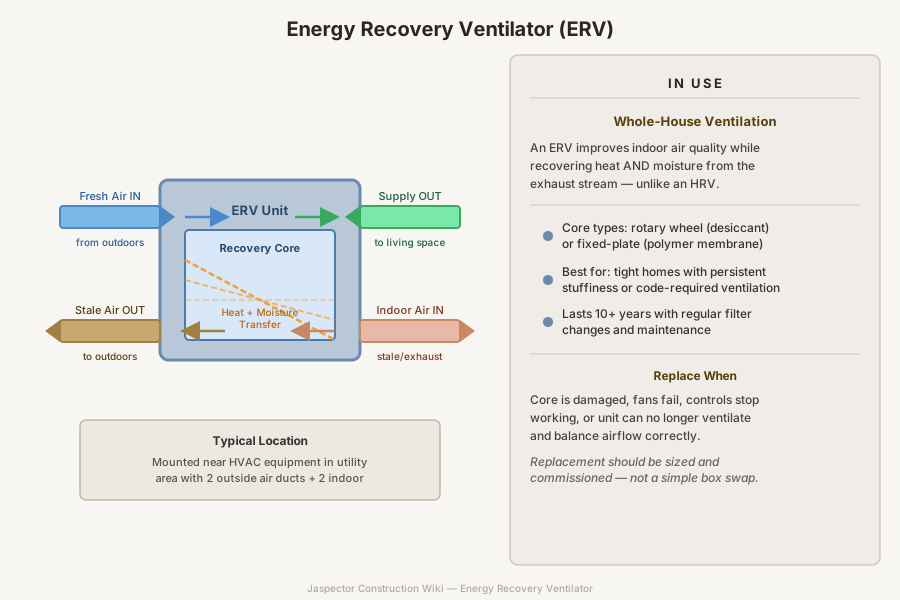
An ERV improves indoor air quality without throwing away as much heating or cooling energy as simple exhaust-only ventilation. Inside the unit, the outgoing stale air passes through a core that transfers sensible heat and some moisture to or from the incoming fresh air, depending on the season.
That makes ERVs especially useful in tighter homes where controlled ventilation matters but comfort and energy use still need to be managed. Unlike a heat recovery ventilator, an ERV transfers moisture as well as heat.
Types
The two main ERV core designs are rotary wheel and fixed-plate. A rotary wheel ERV uses a spinning wheel coated with a desiccant material to transfer both heat and moisture between airstreams as it rotates between intake and exhaust passages. A fixed-plate ERV uses a stationary polymer core with alternating channels separated by a moisture-permeable membrane that allows vapor transfer without moving parts. Fixed-plate units tend to be quieter and need less maintenance, while rotary wheel designs can achieve higher energy recovery efficiency in extreme climates.
Where It Is Used
Energy recovery ventilators are used in newer airtight homes, whole-house ventilation systems, high-performance retrofits, and houses where fresh-air exchange is needed without relying only on opening windows.
How to Identify One
An ERV is usually a metal cabinet near the HVAC equipment or in a utility area with two outside air ducts and two indoor air connections. Labels on the unit often identify it as an ERV and may show filter access doors and condensate or drain provisions depending on the design.
Replacement
Replacement is needed when the core is damaged, fans fail, controls stop working, or the unit can no longer ventilate and balance airflow correctly. Because the equipment interacts with ducting, controls, and house pressure, replacement should be sized and commissioned rather than treated as a simple box swap.
Frequently Asked Questions
Energy Recovery Ventilator (ERV) — FAQ
- What is the difference between an ERV and an HRV?
- An ERV transfers both heat and moisture between the airstreams, while an HRV transfers heat only. That moisture exchange can make an ERV a better fit in many climates and tighter homes.
- Do I need an energy recovery ventilator in my house?
- Not every house does, but tighter homes with persistent stuffiness, indoor air quality concerns, or code-required whole-house ventilation often benefit from one. The answer depends on how airtight the house is and how the existing ventilation works.
- How long does an ERV last?
- Many units last well over a decade with regular filter changes and maintenance, but fan motors, controls, and cores can fail sooner if the system is neglected. Performance problems usually show up as noise, imbalance, frosting, or poor air quality.
- Can I replace an ERV myself?
- A like-for-like swap may look simple, but the airflow balance, controls, and duct connections still need to be right. Improper replacement can create pressure problems or leave the house under-ventilated.
Have a question about your project? Get personalized answers from our team — $9/mo.
MembershipAlso in HVAC
- Air Handler Air Distribution
- Register Air Distribution
- Return Air Grille Air Distribution
- HVAC Filter Air Filtration
- Heat Strip Air Handler Components
- Heating Coil Air Handler Components
- Furnace Blower Air Movement
- Air Filter (HVAC) Air Quality & Filtration