Blocking — What It Is, Where It Goes, and When You Need It
Blocking is a short piece of lumber installed between studs, joists, or rafters to provide a solid nailing surface, add structural reinforcement, or resist racking forces in a wall or floor assembly.
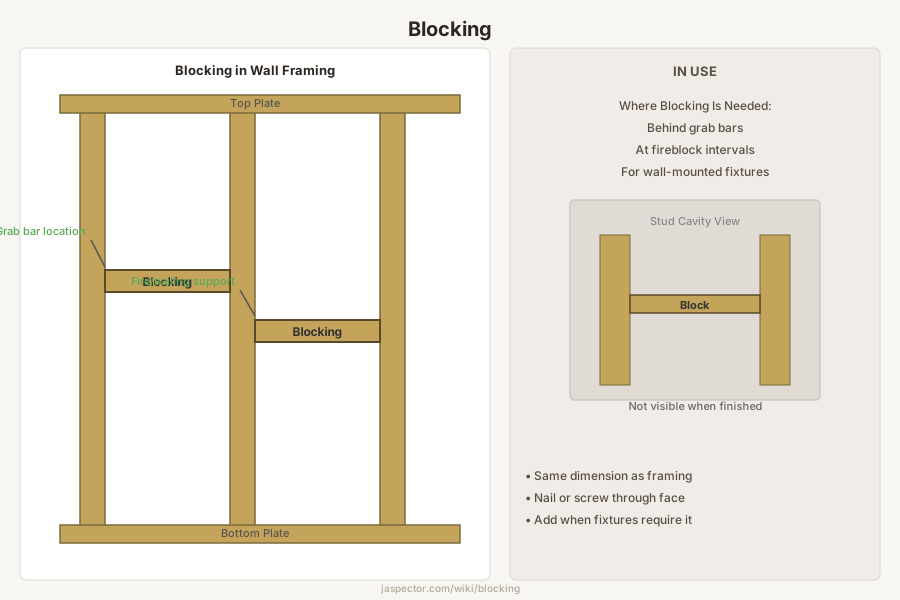
What It Is
Blocking fills the open space between framing members so that finish materials, fixtures, or hardware have something firm to fasten to. Without blocking, screws driven into drywall alone will pull out under load, and walls can rack more easily under lateral stress.
Typical blocking stock is the same dimension lumber as the surrounding framing — 2×4 or 2×6 — cut to fit snugly between members and nailed or screwed through the face of adjacent framing. In some applications, engineered wood products or steel straps are used instead.
Building codes often require blocking at specific intervals for fire resistance, at wall top plates for roof connections, and wherever grab bars, railings, or heavy equipment will be attached.
Types
Nailing blocks provide a surface to attach cabinets, grab bars, or backing board. Fireblocking prevents concealed draft paths inside walls. Bridging blocks stabilize floor joists against rotation. Shear blocks transfer lateral loads between members.
Where It Is Used
Blocking is used inside partition walls behind future grab bars, towel bars, and heavy mirrors; in floor systems between joists to prevent twisting; at stair stringers; and at roof-to-wall connections. It is also required at certain intervals in tall stud walls.
How to Identify One
Blocking is not visible in a finished space. It shows up during framing inspection, demolition, or when walls are opened for renovation. A stud finder that detects the full depth of the cavity sometimes reveals it, but the surest method is a small exploratory hole or thermal imaging.
Replacement
Blocking itself rarely fails, but it may need to be added when a grab bar, wall heater, or heavy fixture is installed in a location that was not framed for attachment. A contractor cuts an access opening, installs the block, and patches the wall surface.
Frequently Asked Questions
Blocking — FAQ
- What is blocking in framing?
- Blocking is a short piece of lumber cut to fit between studs, joists, or rafters. It gives a solid nailing or screwing surface for fixtures, adds lateral stability to wall assemblies, and is sometimes required by code to interrupt hidden air paths that could spread fire.
- Do I need blocking for a grab bar?
- Yes. Grab bars must be anchored into solid framing, not just drywall. If blocking was not installed during original framing, a contractor needs to open the wall, add blocking at the correct height, and patch the surface before the bar is installed.
- How do I know if my walls already have blocking?
- A stud finder can detect blocking if it reads density across the full cavity, but it is not always reliable. The most accurate methods are a small exploratory hole, visual inspection during renovation, or a thermal imaging scan that shows the denser material.
- Is blocking the same as bridging?
- Not exactly. Bridging is a specific type of blocking used between floor joists to resist twisting and distribute loads. Blocking is the broader term covering any short filler piece between framing members, regardless of purpose.
- Can a homeowner add blocking themselves?
- Yes, if the wall or floor is already open and accessible. The work involves cutting lumber to fit, toenailing or face-nailing it in place, and verifying it is flush with the framing face. Opening and patching finished walls is the harder part of the job.
Have a question about your project? Get personalized answers from our team — $9/mo.
MembershipAlso in Structural
- Access Panel Access & Openings
- Attic Hatch Access & Openings
- Construction Adhesive Adhesives & Sealants
- J-Bolt Anchorage
- Expansion Anchor Anchors & Fasteners
- Molly Bolt Anchors & Fasteners
- Baffle (Attic Rafter Vent) Attic & Roof
- Attic Hatch Cover Attic Access