Baluster — Vertical Railing Spindle for Stairs and Decks
A baluster is a vertical spindle installed between the top rail and the floor or bottom rail of a stair or deck railing, filling the open space to prevent falls.
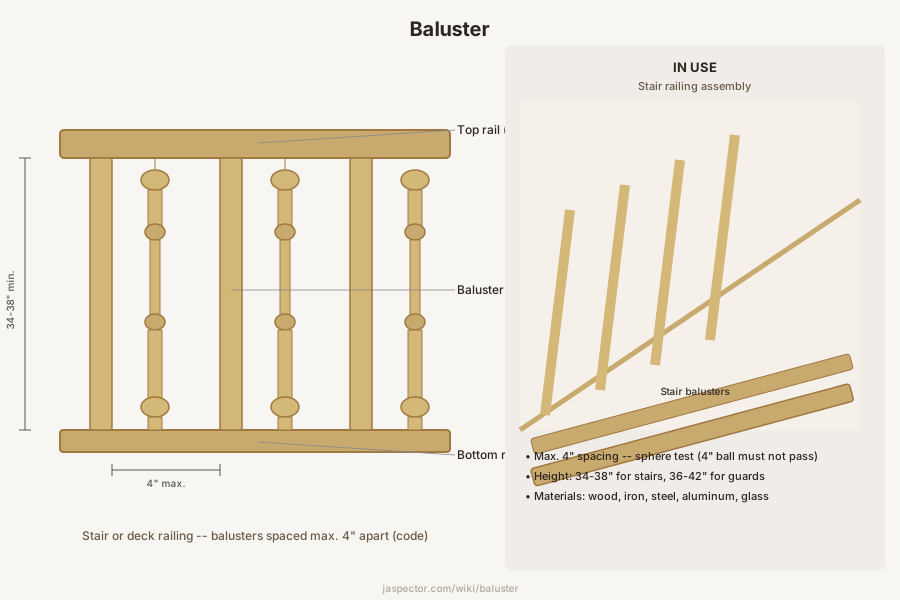
What It Is
Balusters — also called spindles or pickets — are the repeated vertical members that give a railing its infill. They are structural in that they resist lateral force (someone leaning or pushing against the railing), but their primary life-safety function is preventing children from climbing through or falling through open gaps in the railing assembly.
Building codes regulate baluster spacing precisely because of this fall prevention role. The International Residential Code (IRC) requires that balusters be spaced no more than 4 inches apart — close enough that a 4-inch sphere cannot pass through. This dimension is based on the head size of a small child. Deck and stair railings in most jurisdictions follow this same 4-inch rule. Failure to meet this spacing is a code deficiency that must be corrected.
Types
Wood balusters are the most common in interior stairs. Square, turned (lathe-shaped), and flat profile are the main styles. They are typically paint-grade poplar, hemlock, or pine for painted finishes, and oak or maple for stained applications.
Iron and steel balusters include wrought iron (hand-forged, irregular texture) and hollow steel spindles (machine-made, uniform). They are used in both interior and exterior applications and bolt or pin into the tread and rail rather than being glued.
Aluminum balusters are lightweight, rust-resistant, and common in deck railings. They are available in round, square, and flat bar profiles.
Composite and vinyl balusters are used in low-maintenance deck systems. They resist rot and UV degradation but have less structural stiffness than metal.
Cable and glass infill are not balusters in the traditional sense but serve the same code function as railing infill. Cable railings must meet the same 4-inch spacing rule measured horizontally between cables at the most deflected point.
Where It Is Used
Balusters appear in interior stair railings, exterior deck and porch railings, balcony railings, and second-floor loft guardrails. They are required by code wherever a railing is required — typically at any open side of a walking surface more than 30 inches above the floor or grade below.
How to Identify One
A baluster is a vertical member that connects from the stair tread or floor rail up to the top handrail. It is distinct from a newel post, which is the larger structural post at the start or end of a railing run and at landings. Newel posts bear load; balusters fill the space between them. If you can see through a railing, the repeated vertical elements are the balusters.
A loose baluster will move when pushed laterally. A broken baluster will have a visible crack, split, or separation at the tread or rail connection. Either condition is a code and safety issue.
Replacement
Replacing individual balusters is a common repair. Wood balusters are typically glued and pinned at top and bottom; removal involves breaking the glue bond and pulling the pin. Metal balusters use a shoe fitting at top and bottom that unscrews or pops off. Replacement balusters must match the existing profile unless a full railing replacement is being done.
Full railing replacement — new balusters, rail, and posts — triggers a permit in most jurisdictions because the assembly must be inspected for code compliance, including post anchoring, rail height (34 to 38 inches for stairs, 36 to 42 inches for decks depending on height above grade), and baluster spacing. Partial baluster replacement to repair broken or missing units typically does not require a permit, though the repaired assembly must still meet current spacing requirements.
Baluster replacement cost for a single unit runs $20 to $80 in material plus 30 to 60 minutes of labor. Full deck railing replacement with new posts and balusters typically runs $60 to $120 per linear foot installed.
Frequently Asked Questions
Baluster — FAQ
- What is the difference between a baluster and a newel post?
- A baluster is one of the repeated vertical spindles that fill the space between the top rail and the floor or bottom rail. A newel post is the larger, structural post at the beginning, end, or landing of a stair railing run. Newel posts bear the load of the railing system; balusters are the infill that prevents falls between the posts. A railing always has both.
- How far apart can balusters be spaced?
- The IRC and most local codes require that balusters be spaced no more than 4 inches apart — the standard is that a 4-inch sphere must not be able to pass through any opening in the railing. This applies to stair railings, deck railings, and loft guardrails. If you can slide a 4-inch ball through a gap in your railing, the spacing is a code violation and a fall hazard.
- What causes balusters to become loose?
- Wood balusters become loose when the glue at the tread or rail connection dries out and fails — this is especially common in dry climates or heated interiors where wood cycles through seasonal moisture changes. Metal balusters can loosen if the shoe fittings corrode or were not properly set. A loose baluster should be re-secured promptly; a railing with multiple loose spindles may have a failing post connection that requires professional evaluation.
- Do I need a permit to replace balusters?
- Replacing individual damaged or missing balusters as a repair typically does not require a permit. Replacing an entire railing system — new posts, rails, and balusters — requires a permit in most jurisdictions because the work is inspected for rail height, post anchoring, and baluster spacing. When in doubt, check with your local building department before starting.
- How much does it cost to replace a deck railing with new balusters?
- Full deck railing replacement with new posts, rails, and balusters typically costs $60 to $120 per linear foot installed, depending on material (composite and aluminum systems cost more than pressure-treated wood) and local labor rates. A 40-linear-foot deck railing runs $2,400 to $4,800 installed. Replacing only damaged individual balusters is much less — typically $20 to $80 per baluster in material plus labor.
Have a question about your project? Get personalized answers from our team — $9/mo.
MembershipAlso in Structural
- Access Panel Access & Openings
- Attic Hatch Access & Openings
- Construction Adhesive Adhesives & Sealants
- J-Bolt Anchorage
- Expansion Anchor Anchors & Fasteners
- Molly Bolt Anchors & Fasteners
- Baffle (Attic Rafter Vent) Attic & Roof
- Attic Hatch Cover Attic Access