Backing Board — What It Is and Why It Matters for Grab Bars
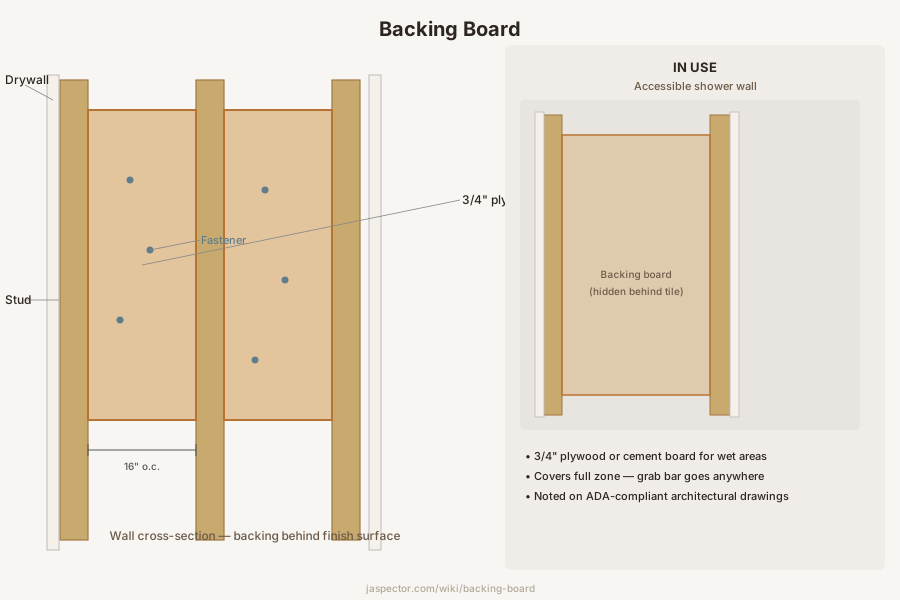
A backing board is a panel or sheet of material installed behind wall finish surfaces to create a continuous, solid substrate for attaching fixtures, hardware, or finish materials that cannot rely on stud spacing alone.
What It Is
Unlike blocking, which targets specific attachment points, a backing board covers a broad area — often an entire wall section — so that fixtures can be positioned anywhere within that zone without locating individual studs. Common materials include plywood, oriented strand board, cement board, and high-density polyethylene panels.
Backing board is particularly common in accessible bathrooms, where ADA-compliant grab bar locations must accommodate a range of user needs and exact placement may not be determined until after framing is complete.
The board is nailed or screwed to the stud faces before drywall or tile backer is applied, becoming an invisible but load-bearing layer in the wall assembly.
Types
Plywood backing (typically 3/4-inch) is the most common choice for grab bars and heavy hardware. Cement board backing is used in wet areas where moisture resistance matters. Specialty HDPE backing panels are designed for healthcare and accessibility applications and allow screw attachment anywhere on their surface without fastener pullout.
Where It Is Used
Backing board is installed in shower walls for future grab bars, behind vanity areas for heavy mirrors and medicine cabinets, along stair walls for railings, and in any location where fixture placement may vary or is not yet determined during framing.
How to Identify One
A backing board is hidden behind the finish wall and is not visible in a completed space. It may be noted on architectural drawings or discovered when walls are opened. Probing with a fastener or stud finder across a wide area that returns consistent solid hits suggests a backing board rather than individual studs.
Replacement
Backing board does not wear out under normal conditions. It may need to be added during renovation when accessible grab bars or heavy fixtures are required in a space that was not originally designed for them.
Frequently Asked Questions
Backing Board — FAQ
- What is a backing board used for?
- A backing board is installed behind wall finish materials to give fixtures, grab bars, and hardware a solid surface to fasten to across a broad area. It removes the need to hit individual studs when mounting items, which is especially useful when final fixture placement is not fixed during framing.
- What material should I use for backing board behind grab bars?
- Three-quarter-inch plywood is the standard choice and meets most code requirements for grab bar blocking. In wet areas, cement board or pressure-treated plywood is preferred. HDPE specialty panels are used in healthcare settings where corrosion resistance and repositionable fastening matter.
- Is backing board the same as blocking?
- They serve the same purpose — solid attachment for fixtures — but differ in coverage. Blocking is a short piece targeting a specific point. Backing board is a full panel that covers a wall zone, allowing flexible fixture placement anywhere within that area.
- Does backing board affect tile installation?
- Yes. Adding a backing board layer behind cement board or drywall increases wall thickness slightly, which can affect how tile, trim, and fixtures fit. Installers account for this when planning the full wall assembly thickness.
- Can I add backing board without opening the wall?
- Not easily. Backing board needs to be fastened to the stud faces before finish materials are applied. In an existing wall, adding it typically requires opening the surface, which means drywall or tile removal and patching.
Have a question about your project? Get personalized answers from our team — $9/mo.
MembershipAlso in Structural
- Access Panel Access & Openings
- Attic Hatch Access & Openings
- Construction Adhesive Adhesives & Sealants
- J-Bolt Anchorage
- Expansion Anchor Anchors & Fasteners
- Molly Bolt Anchors & Fasteners
- Baffle (Attic Rafter Vent) Attic & Roof
- Attic Hatch Cover Attic Access