Backer Rod - Foam Joint Filler Installation and Repair Guide
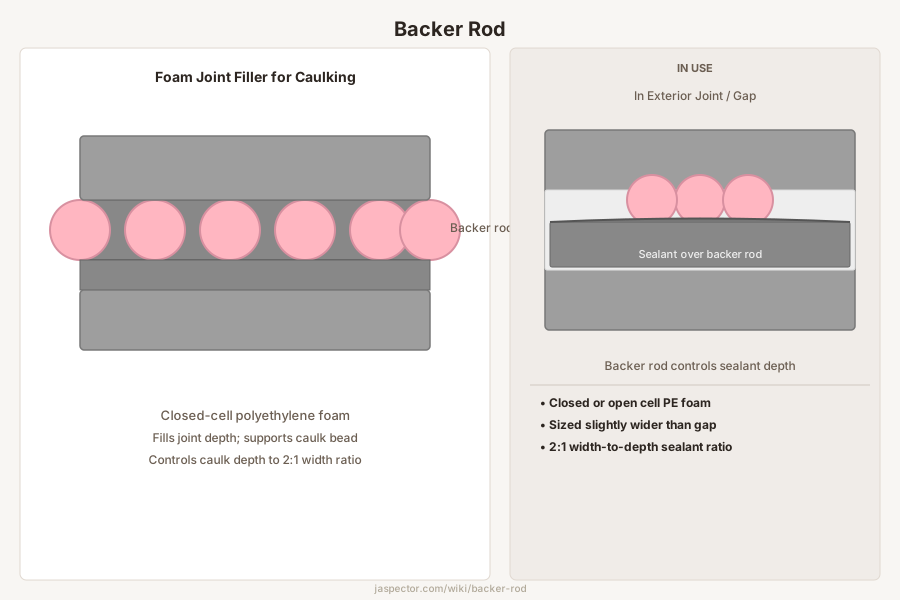
A backer rod is a compressible foam rope installed in a joint before sealant so the caulk bonds correctly and stretches without failing.
What It Is
Backer rod is placed into a gap or control joint to set the proper depth for sealant and keep the sealant from sticking to the bottom of the joint. That two-sided bond is important because most sealants need to stretch and compress as the building moves, and a three-sided bond makes premature cracking and loss of adhesion more likely.
It is commonly made from closed-cell or open-cell foam and is sized slightly larger than the joint so it stays in place when pressed in. In practical terms, backer rod improves sealant performance, reduces how much sealant is needed, and helps the finished joint last longer.
Types
Closed-cell backer rod is denser and resists water absorption, so it is commonly used in exterior joints and areas exposed to weather.
Open-cell backer rod is softer and more compressible, which can help in irregular joints, but it is less suited to wet exposure.
Soft backer rod is used where a very low compression force is needed to avoid stressing delicate joint edges.
Where It Is Used
Backer rod is used in concrete control joints, expansion joints, window and door perimeters, siding transitions, masonry joints, and gaps where dissimilar materials meet. It is common in both exterior envelope work and interior movement joints.
How to Identify One
You usually see backer rod only before the sealant is installed or where a failed joint has opened up. It looks like a round foam cord recessed below the visible surface of the caulk line. If the joint is packed solid with sealant all the way through or stuffed with random filler, backer rod may be missing.
Replacement
Backer rod is replaced when a sealed joint is being rebuilt because the old sealant has failed, the joint was filled at the wrong depth, or the foam has deteriorated. Proper replacement means removing the old sealant, cleaning the joint faces, installing correctly sized backer rod, and then applying new sealant at the proper depth.
Frequently Asked Questions
Backer Rod — FAQ
- What does backer rod do in a caulk joint?
- Backer rod controls the depth of the sealant and keeps the caulk from bonding to the bottom of the joint. That lets the sealant stretch properly as the materials expand and contract.
- Can I caulk a large gap without backer rod?
- You can, but it is usually a poor detail. Deep sealant alone wastes material and is more likely to split, shrink, or lose adhesion because the joint geometry is wrong.
- How do I choose the right size backer rod?
- Backer rod is typically selected slightly larger than the joint width so it compresses and stays in place. If it is too small it will fall out, and if it is too large it can distort the joint or be difficult to install evenly.
- Is backer rod waterproof?
- Closed-cell backer rod resists water much better than open-cell products, which is why it is preferred outdoors. It is still part of a sealant system, not a stand-alone waterproofing layer.
- When should backer rod be replaced?
- It should be replaced any time a failed sealant joint is being rebuilt or when the existing foam is damaged, missing, or installed at the wrong depth. Reusing old backer rod usually leads to a shorter-lived repair.
Have a question about your project? Get personalized answers from our team — $9/mo.
MembershipAlso in Exterior
- Extension Ladder Access & Safety
- Concealed Hinge Cabinet Hardware
- Board and Batten Cladding
- EIFS (Exterior Insulation Finish System) Cladding
- Hardboard Siding Cladding
- Shake Siding Cladding
- Siding Cladding
- Stone Veneer Cladding