Arch Brick — Voussoirs, Keystones, and Brick Arch Repair
An arch brick is a wedge-shaped masonry unit cut or molded to a tapered profile so that a course of bricks can form a curved arch over an opening.
What It Is
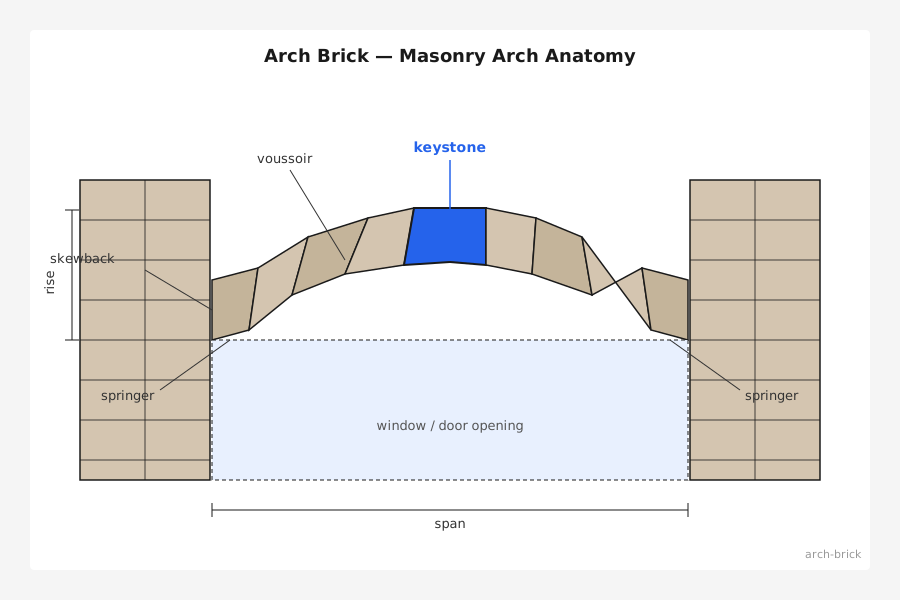
Arch bricks are the individual wedge-shaped units that make up a masonry arch. Each unit — called a voussoir — is wider at the outer face (extrados) and narrower at the inner face (intrados), so that a ring of them forms a self-supporting curve. The central unit at the crown is the keystone, which locks the arch together. At each end of the arch, the last voussoir bears against a flat or angled skewback cut into the adjacent masonry; the lowest voussoir in the arch is called the springer.
The geometry of the arch means that vertical loads are converted into compressive forces that travel along the arch curve into the supports. Masonry handles compression well, so a properly built arch can carry significant load with no steel lintel required. However, the arch also generates outward horizontal thrust at the springers, which must be resisted by the wall mass or buttresses on each side.
Arch bricks may be purpose-manufactured in a fixed taper, or standard bricks may be cut on-site to the required wedge angle. Rubbed and gauged arches use very precise thin joints; rough-cut arches use wider mortar joints to accommodate the curvature.
Types
Flat arch (jack arch) uses wedge-shaped voussoirs arranged so the arch appears nearly horizontal, with only a slight camber. Common over windows and door heads.
Segmental arch follows an arc that is less than a semicircle. It is the most common curved arch shape in residential brick construction.
Semicircular arch forms a full half-circle. Used in traditional and classical styles where the opening height can accommodate the rise.
Gauged arch uses soft, hand-cut rubbed bricks with very thin joint lines for a precise, decorative appearance.
Where It Is Used
Arch bricks appear over window and door openings in brick facades, in fireplace surrounds, in garden walls, and in tunnel or passage openings. They are common in older brick buildings from the 19th and early 20th centuries before steel lintels became standard.
How to Identify One
Look above a window or door in a brick wall for a visible curve or flat band of bricks with radiating joints fanning toward a center keystone. The joints will converge toward the interior of the arch, confirming that the bricks are wedge-shaped. In gauged arches, the joints are very fine and the bricks may appear cut to near-perfect symmetry.
Replacement
Damaged or displaced arch bricks require careful removal to avoid disturbing the surrounding masonry. The arch must be temporarily supported with a timber or steel form (centering) before any voussoirs are removed. Replacement bricks should match the original in size, color, and taper. The mortar joint profile and mix should also match existing conditions to avoid differential expansion and visual mismatch. Arch repairs are not a DIY project — improper removal without shoring can cause the arch to collapse or overload the surrounding wall.
Frequently Asked Questions
Arch Brick — FAQ
- What is the keystone in a brick arch?
- The keystone is the central wedge-shaped brick at the crown of the arch. It is the last unit placed during construction and locks the two sides of the arch together by completing the compression ring. Displacement or cracking of the keystone is a serious warning sign.
- Do brick arches need a steel lintel behind them?
- Not necessarily. A true structural arch transfers load as compression through the voussoirs into the supports without needing a steel lintel. However, many modern brick arches are purely decorative, with a concealed steel lintel doing the actual structural work and the brick arch serving as cladding.
- What does it mean when mortar falls out of a brick arch?
- Mortar deterioration in an arch joint reduces the arch's ability to transfer load and can allow individual voussoirs to shift. Open joints also let water in, which accelerates freeze-thaw damage. Tuckpointing is the usual repair, but the arch geometry must be checked before work begins.
- When does a cracked brick arch need professional attention?
- Any visible displacement of voussoirs, cracking that follows the arch curve, stair-step cracking in the supporting piers, or bowing in the arch plane warrants prompt evaluation by a mason or structural engineer. These patterns can indicate movement, inadequate bearing, or failed supports.
- How much does it cost to repair a brick arch over a window?
- Minor repointing of an arch typically costs $200–$600 per opening. Replacing several voussoirs with proper shoring and matching brick runs $800–$2,500 or more per opening depending on arch size, brick availability, and scaffold requirements.
Have a question about your project? Get personalized answers from our team — $9/mo.
MembershipAlso in Masonry
- Epoxy Anchor Anchors & Fasteners
- Masonry Anchor Anchors & Fasteners
- Wall Tie Anchors & Fasteners
- Brick Ledge
- Corbel
- Face Brick
- Tuckpointing Mortar
- Smoke Chamber Chimney Masonry