Anchor Bolt — Foundation Fastener for Sill Plates Guide
An anchor bolt is a threaded fastener embedded in concrete — typically a foundation wall, slab, or footing — used to secure sill plates, posts, or structural steel members to the foundation and resist lateral movement.
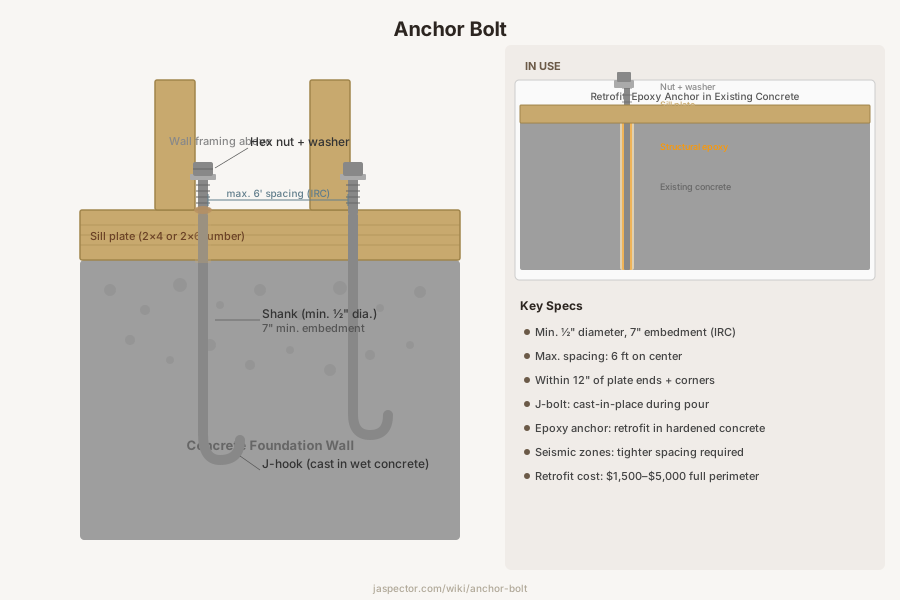
What It Is
Anchor bolts are the critical link between a structure's wood framing and its concrete foundation. In wood-frame construction, the sill plate — the lowest horizontal framing member — sits directly on top of the concrete foundation wall. Anchor bolts pass through holes in the sill plate and are secured with a nut and washer, clamping the plate to the concrete and transferring lateral loads (from wind or seismic forces) from the framing into the foundation.
Without properly installed anchor bolts, a structure can slide off its foundation during an earthquake or high-wind event. This is the primary life-safety hazard anchor bolts address. Building codes specify the minimum diameter, embedment depth, spacing, and distance from corners and plate ends. The International Residential Code requires anchor bolts to be at least 1/2 inch in diameter, embedded at least 7 inches into concrete, and spaced no more than 6 feet apart for standard conditions. Seismic zones have more stringent requirements.
Anchor bolts are set in wet concrete before it cures, or installed in hardened concrete using epoxy or mechanical expansion anchors when retrofitting. Cast-in-place bolts offer the highest holding strength; epoxy anchors in existing concrete are the most common retrofit method.
Types
J-bolt (bent anchor bolt) is the most common type for new construction. The J-shaped bend at the bottom hooks into fresh concrete, providing pullout resistance. Installed before the pour or while concrete is still wet.
L-bolt is similar to a J-bolt but with a 90-degree bend. Used in the same applications.
Headed anchor bolt has a flat plate or hex head at the embedded end instead of a bend. Offers higher pullout resistance in some configurations.
Epoxy anchor bolt (threaded rod) is used in retrofit applications. A hole is drilled in existing concrete, flushed clean, filled with structural epoxy, and the threaded rod is inserted. Once cured, it achieves strength comparable to a cast-in-place bolt.
Mechanical expansion anchor uses a sleeve that expands against the drilled hole as the nut is tightened. Lower cost than epoxy but also lower seismic performance. Not accepted in all jurisdictions for sill plate anchoring.
Where It Is Used
Anchor bolts appear at the top of concrete foundation walls, stem walls, and slabs. They secure sill plates in wood-frame houses, anchor posts to concrete piers in deck construction, and attach structural steel columns to concrete footings in commercial and heavy residential applications. Interior slab applications include anchoring partition walls and mechanical equipment.
How to Identify One
Look at the top of the foundation wall where it meets the lowest framing. Anchor bolts appear as threaded rods protruding from the concrete, typically spaced 4–6 feet apart, passing through the sill plate with a nut and square washer visible on top. In homes without a visible foundation (slab-on-grade), the anchor bolts may be covered by drywall at the base of exterior walls.
Replacement
Adding or replacing anchor bolts in existing concrete is a retrofit process that requires drilling into the foundation and installing epoxy or expansion anchors. This is commonly done as a seismic retrofit in earthquake-prone regions. A structural engineer should specify anchor size, spacing, and epoxy type for retrofit projects. Permits are required in most jurisdictions. Costs for a full sill plate bolting retrofit range from $1,500 to $5,000 depending on foundation perimeter and access.
Frequently Asked Questions
Anchor Bolt — FAQ
- Why are anchor bolts important in a home inspection?
- An inspector checks that anchor bolts are present, properly spaced, and have nuts and washers tightened to the sill plate. Missing or improperly installed bolts are a structural deficiency — without them, the framing can slide off the foundation in an earthquake or high-wind event. In seismic regions, inadequate anchor bolting is a common finding in pre-1980s homes.
- How far apart should anchor bolts be spaced?
- The International Residential Code requires anchor bolts no more than 6 feet apart, within 12 inches of each end of every sill plate section, and within 12 inches of corners. Seismic and high-wind zones have tighter spacing requirements — sometimes as close as 4 feet or less. Check with your local building department for the applicable standard in your area.
- Can anchor bolts be added to an existing foundation?
- Yes. Epoxy anchor bolts can be installed in existing concrete by drilling holes, cleaning them with compressed air, injecting structural epoxy, and inserting threaded rods. When properly installed, epoxy anchors achieve strength comparable to cast-in-place bolts. This retrofit is commonly required in earthquake zones and is a permitted structural project.
- Do I need a permit to add anchor bolts to my foundation?
- Yes. Adding anchor bolts to a sill plate is a structural repair that requires a permit in most jurisdictions. Seismic retrofits are inspected to verify correct anchor size, spacing, and embedment. Some areas offer streamlined permit processes for standard seismic retrofit scopes. Always pull the permit — unpermitted structural work creates liability and complicates future sales.
- What is the difference between a J-bolt and an epoxy anchor bolt?
- A J-bolt is embedded in wet concrete during the original pour — its bent end hooks into the concrete for pullout resistance. It cannot be added after concrete has cured. An epoxy anchor bolt is a retrofit method: a hole is drilled in hardened concrete, filled with structural epoxy, and a threaded rod is inserted. Epoxy anchors are the standard repair method for upgrading existing foundations.
- How much does a seismic anchor bolt retrofit cost?
- A full sill plate bolting retrofit for a typical single-family home costs $1,500–$5,000 depending on the foundation perimeter, accessibility, and local labor rates. Homes with cripple walls (short stud walls between the foundation and first floor) may also need structural plywood sheathing added at the same time, which increases cost. Some states and cities offer grants or low-interest loans for seismic retrofits.
Have a question about your project? Get personalized answers from our team — $9/mo.
MembershipAlso in Structural
- Access Panel Access & Openings
- Attic Hatch Access & Openings
- Construction Adhesive Adhesives & Sealants
- J-Bolt Anchorage
- Expansion Anchor Anchors & Fasteners
- Molly Bolt Anchors & Fasteners
- Baffle (Attic Rafter Vent) Attic & Roof
- Attic Hatch Cover Attic Access